 Yandiya Technology HK Ltd
Yandiya Technology HK Ltd › Blog › What Size Infrared Heating Panel Do I Need for a 20-Square-Metre Room?
← All articlesWhat Size Infrared Heating Panel Do I Need for a 20-Square-Metre Room?

Key takeaways
- For a standard-insulated 20 m² room, use 1,200 W of Yandiya infrared heating.
- Choose one 1,200 W panel for a compact room or two 600 W panels for long, irregular or separately occupied spaces.
- A 1,000 W panel is undersized against the listed standard-insulation coverage range for 20 m².
- Ceiling height and mounting-height guidance are separate from heat-load sizing.
- Use a room-by-room heat-loss calculation for poorly insulated, draughty, high-ceilinged or unusually exposed rooms.
- Use qualified electrical installation and suitable thermostat control.
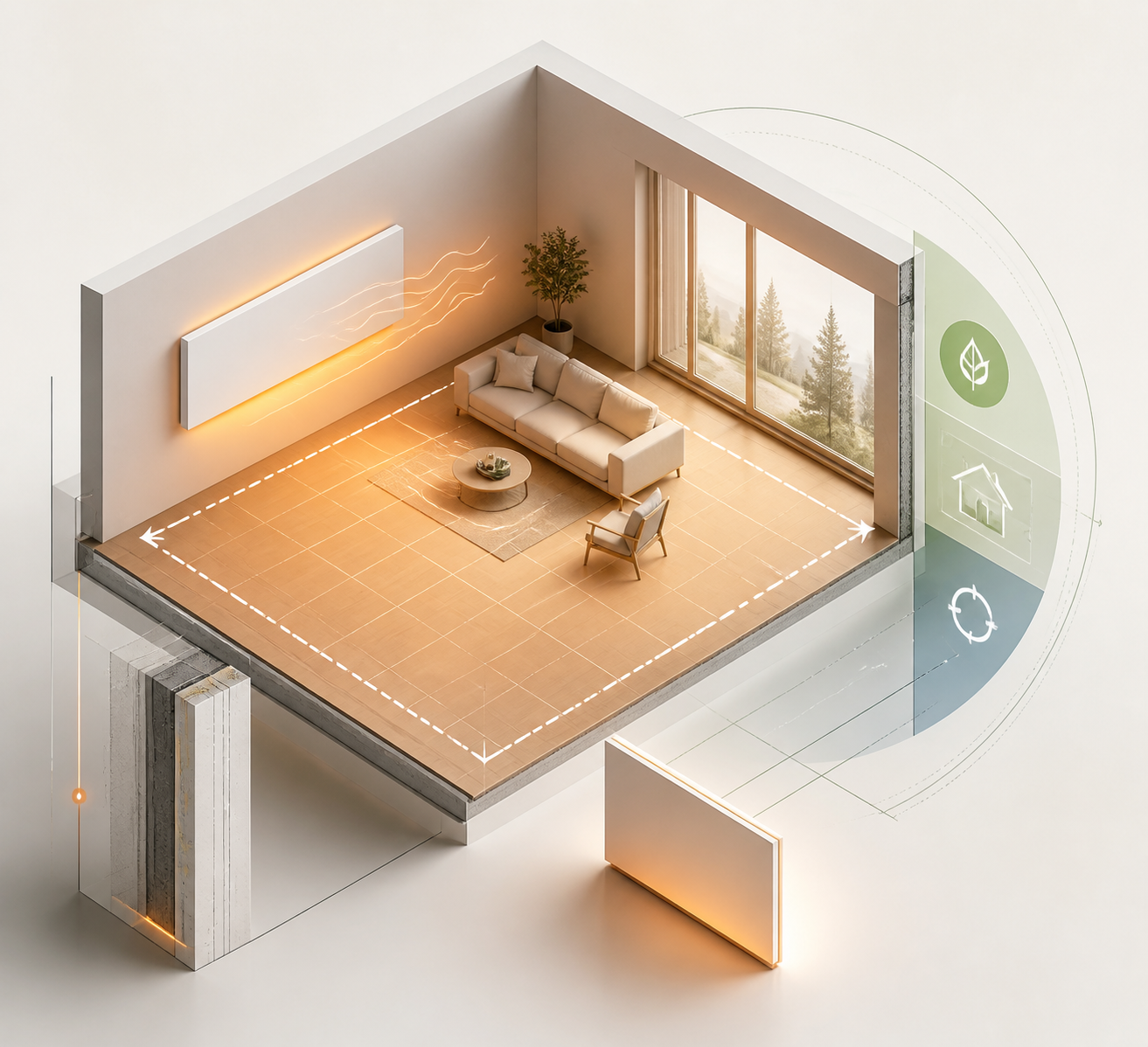
For a standard-insulated 20 m² room, use 1,200 W of Yandiya infrared heating.
Choose one 1,200 W IH1200 panel for a compact room, or use two 600 W panels when the room is long, irregular, heavily glazed or divided into separate occupied areas.
What size infrared heating panel is right for a 20 m² room?
For a standard-insulated 20 m² room, use 1,200 W of Yandiya infrared heating.
The product-selection shortcut is based on the listed coverage range for the aluminium panel range: the 1,200 W model covers 17.64–21.24 m², while the 1,000 W model covers 14.70–16.67 m². A single 1,000 W panel is therefore undersized against that stated standard-insulation coverage range, although it is not universally inadequate for every 20 m² room because actual heating demand depends on heat loss.
The 1,200 W option can be installed as:
- One 1,200 W IH1200 panel for a compact or square room.
- Two 600 W panels for more flexible placement and heat distribution.
The 1,200 W recommendation is a product-selection shortcut, not an engineering-grade heat-loss calculation. A proper design calculates the room’s heat loss from the building fabric, ventilation, outdoor design temperature, glazing, ceiling height and target indoor temperature.
What does “standard insulation” mean?
In this article, standard insulation means a room with insulated walls, roof or ceiling and floor, functioning double glazing, a ceiling close to 2.4 m, ordinary levels of air leakage, and no unusually large exposed wall or window area.
This baseline describes a reasonably typical insulated room in a temperate climate. It does not describe a draughty older room, a conservatory, a room with single glazing, a high-ceilinged space or a room with several exposed external walls.
If the room falls outside this baseline, treat 1,200 W as a product-selection reference and obtain a room-by-room heat-loss calculation before finalising the heater size.
Should I choose one 1,200 W panel or two 600 W panels?
Choose one 1,200 W panel for a compact room and two 600 W panels when the room layout makes one large panel difficult to position effectively.
Both arrangements provide 1,200 W total output, but the layout determines which configuration is more practical:
| Room condition | Recommended configuration | Why |
|---|---|---|
| Compact or square 20 m² room | One 1,200 W panel | Simpler installation and one central heating zone |
| Long or narrow room | Two 600 W panels | Places heat closer to separate parts of the room |
| L-shaped or irregular room | Two 600 W panels | Reduces dead areas caused by the room shape |
| Large window or cold external wall | Two 600 W panels | Allows more deliberate placement near occupied or colder zones |
| Need for separate schedules | Two 600 W panels with suitable controls | Supports zoning where the electrical and control design allows it |
Panel placement should provide clear exposure to the main occupied area. Avoid positioning a panel behind tall furniture, close to obstructions or where fittings prevent the panel from radiating toward the space that needs heating.
Is a 1,000 W panel enough for a 20 m² room?
A single 1,000 W panel is below the listed standard-insulation coverage range for a 20 m² room and should not be selected as the product-range shortcut for that room size.
The 1,000 W model is listed for 14.70–16.67 m², compared with 17.64–21.24 m² for the 1,200 W model. That comparison identifies the 1,200 W model as the better match for the stated baseline; it does not prove that every 20 m² room using 1,000 W will fail to reach its target temperature.
A 1,000 W panel may perform differently depending on climate, insulation, glazing, ceiling height, air leakage, internal heat gains and thermostat settings. Use a heat-loss calculation when the room has demanding conditions.
How does insulation affect the required panel size?
Insulation affects panel sizing by changing how quickly the room loses heat through its walls, windows, ceiling, floor and ventilation.
A poorly insulated or draughty room needs more installed heating capacity than a well-insulated room of the same floor area. Large windows, several external walls, high ceilings, frequent door opening and low outdoor temperatures can also increase the required output.
Use this decision rule:
1. Standard-insulation room: select 1,200 W for 20 m².
2. Long, irregular or divided room: use two 600 W panels totalling 1,200 W.
3. Poorly insulated, draughty, high-ceilinged or heavily glazed room: obtain a room-by-room heat-loss calculation.
4. Room with improved insulation or partial heating needs: size the system for the actual heated zone and design temperature rather than floor area alone.
Does ceiling height affect infrared panel sizing?
Ceiling height affects heating design, but a mounting-height limit does not by itself validate the wattage recommendation.
The aluminium-panel specifications give a maximum mounting height of 2.4 m. Treat that as installation guidance separate from the 1,200 W product-selection recommendation. A room above 2.4 m can have greater heated volume and a different heat-loss profile, so the design may require revised panel placement, additional output or a formal heat-loss calculation.
Whether the panel is wall-mounted or ceiling-mounted, keep its effective radiating area clear. Wall mounting can direct heat toward a sofa, desk or dining area, while ceiling mounting can suit an open room with sufficient clearance.
What electrical requirements should I consider?
A 1,200 W panel operating at 230 V draws about 5.2 A, so the installation needs a correctly rated supply, control equipment and protective arrangement.
The product specifications list 220–240 V AC operation and connection through a fused spur or direct connection, depending on the installation. Two 600 W panels draw the same combined power as one 1,200 W panel, but separate controls, wiring routes and thermostat zones can change the installation design.
Use a qualified electrician for the electrical design and installation, particularly where the panels are hard-wired, installed in a bathroom or connected to more than one heating zone.
How should I position an infrared panel?
Position the panel so its active surface has clear exposure to the main occupied area and is not blocked by tall furniture or permanent fittings.
For one 1,200 W panel, a central ceiling position or a wall position facing the main occupied zone is usually the simplest layout. For two 600 W panels, place the panels to serve separate parts of the room rather than mounting both where their heated areas substantially overlap.
Maintain the manufacturer’s clearances and mounting-height requirements, and do not treat panel placement as a substitute for adequate total output.
Does thermostat zoning matter?
Thermostat zoning matters because it lets separate panels respond to the temperatures and occupancy patterns of different parts of a room or building.
One 1,200 W panel is straightforward to operate from one thermostat. Two 600 W panels can be connected to one control system or arranged in separate zones where the controls and electrical installation support that configuration.
Zoning is most useful when one part of the space is occupied more often, receives more solar gain or has a different exposure from the rest of the room. Zoning does not increase the total heating capacity: two 600 W panels still provide 1,200 W combined.
Why is two 600 W panels sometimes preferable?
Two 600 W panels are preferable when the room’s shape, furniture or occupancy pattern makes one 1,200 W panel difficult to position evenly.
Use two panels when:
- The room is long, narrow or L-shaped.
- A single mounting position would leave one end of the room distant from the heating zone.
- Separate seating, desk or dining areas need more balanced coverage.
- You want the option of separate thermostat schedules.
- Available wall or ceiling space cannot accommodate the 1,200 W panel in a suitable position.
Use one 1,200 W panel when the room is compact and a single clear mounting position can serve the occupied area.
Is infrared heating more efficient than convection heating?
Infrared panels convert electricity into heat at the point of use, but their running cost and overall performance still depend on the room’s heat loss, thermostat settings, operating hours and electricity price.
Infrared panels transfer heat by radiation as well as convection from their warm surfaces, but this does not establish automatic energy savings compared with another electric resistance heater delivering the same heat to the same room. Avoid choosing the panel size on efficiency claims alone; size it for the room’s required heat output and control it with an appropriate thermostat.
What are the key takeaways?
- For a standard-insulated 20 m² room, use 1,200 W of Yandiya infrared heating.
- Choose one 1,200 W panel for a compact room.
- Choose two 600 W panels for long, irregular, heavily glazed or separately occupied spaces.
- A 1,000 W panel is undersized against the listed standard-insulation coverage range for 20 m².
- Ceiling height, mounting height and heat-load sizing are separate considerations.
- Obtain a heat-loss calculation for poorly insulated, draughty, high-ceilinged or unusually exposed rooms.
- Use qualified electrical installation and suitable thermostat control.
Frequently asked questions
Is a 1,000 W infrared panel enough for a 20 m² room?
A single 1,000 W panel is below the listed standard-insulation coverage range for 20 m², so 1,200 W is the better product-selection match; actual adequacy still depends on the room’s heat loss.
Can I use two 600 W panels instead of one 1,200 W panel?
Yes, two 600 W panels provide the same 1,200 W total output and are preferable when the room is long, irregular, heavily glazed or divided into separate occupied zones.
Where should I install an infrared panel?
Install it where the panel has clear exposure to the main occupied area, with the required clearances and without tall furniture or fittings blocking its radiating surface.
Do I need more than 1,200 W in a poorly insulated room?
A poorly insulated, draughty, high-ceilinged or heavily glazed 20 m² room may need more than 1,200 W, so use a room-by-room heat-loss calculation rather than the standard-insulation shortcut.
Do two panels need two thermostats?
Two panels can operate from one thermostat, while separate thermostats or zones are useful when different parts of the room have different occupancy or temperature requirements.
What electrical circuit does a 1,200 W panel need?
A 1,200 W panel draws about 5.2 A at 230 V and needs a correctly rated supply, control arrangement and protective device installed by a qualified electrician.
Is one large panel better than two smaller panels?
One large panel is simpler for a compact room, while two smaller panels usually provide more flexible and balanced placement in long, irregular or divided spaces.
Sources
- Yandiya, “Aluminium Far Infrared Heating Panels 350W–1200W.” Product models, wattages, listed coverage ranges, dimensions, electrical specifications and maximum mounting height. (yandiya.net)
- Department for Energy Security and Net Zero, “Home Energy Model: technical documentation.” Official technical documentation covering space-heating demand, fabric heat loss, ventilation and infiltration heat loss. Updated March 3, 2026. (gov.uk)
- Department for Energy Security and Net Zero, “Calculating space heating and cooling demand within the Home Energy Model.” Official technical paper describing heat-balance calculations and the factors used to determine space-heating demand. (assets.publishing.service.gov.uk)
> Disclaimer: The 1,200 W recommendation is a product-selection shortcut for the standard-insulation baseline defined in this article, not a substitute for an engineering-grade heat-loss calculation. Actual requirements vary with climate, insulation, glazing, ceiling height, external exposure, air leakage, target temperature and occupancy. Confirm product availability, specifications, clearances and local electrical requirements before installation.
References
- https://www.gov.uk/government/publications/heat-and-buildings-strategy/heat-and-building-strategy-accessible-webpage
FAQ
Is a 1,000 W infrared panel enough for a 20 m² room?
A single 1,000 W panel is below the listed standard-insulation coverage range for 20 m², so 1,200 W is the better product-selection match; actual adequacy still depends on the room’s heat loss.
Can I use two 600 W panels instead of one 1,200 W panel?
Yes, two 600 W panels provide the same 1,200 W total output and are preferable when the room is long, irregular, heavily glazed or divided into separate occupied zones.
Where should I install an infrared panel?
Install it where the panel has clear exposure to the main occupied area, with the required clearances and without tall furniture or fittings blocking its radiating surface.
Do I need more than 1,200 W in a poorly insulated room?
A poorly insulated, draughty, high-ceilinged or heavily glazed 20 m² room may need more than 1,200 W, so use a room-by-room heat-loss calculation rather than the standard-insulation shortcut.
Do two panels need two thermostats?
Two panels can operate from one thermostat, while separate thermostats or zones are useful when different parts of the room have different occupancy or temperature requirements.
What electrical circuit does a 1,200 W panel need?
A 1,200 W panel draws about 5.2 A at 230 V and needs a correctly rated supply, control arrangement and protective device installed by a qualified electrician.
Is one large panel better than two smaller panels?
One large panel is simpler for a compact room, while two smaller panels usually provide more flexible and balanced placement in long, irregular or divided spaces.
About the author
Yandiya Technology HK Ltd, a global leader in manufacturing infrared heating, is a beacon of innovation and efficiency. We have pioneered the development and application of infrared heating technology, transforming the way people heat their homes and businesses across the world.