 Yandiya Technology HK Ltd
Yandiya Technology HK Ltd › Blog › Can I Connect Multiple Infrared Heating Panels to One Smart Heating Control System?
← All articlesCan I Connect Multiple Infrared Heating Panels to One Smart Heating Control System?

Key takeaways
- Multiple infrared panels can share one smart control system only when they are electrically compatible, within the switching equipment’s rating and assigned to one heating zone.
- Use one thermostat plus a correctly specified relay or contactor for one zone when the thermostat cannot switch the total heater load directly.
- Use separate thermostats or independently switched outputs for rooms with different temperatures, schedules or occupancy patterns.
- Grouped Wi-Fi or Zigbee panels can share app commands, but app grouping does not necessarily create one shared temperature sensor or synchronized thermostat control.
- Calculate current from total wattage divided by actual supply voltage, then have a qualified electrician design the circuit protection, cable sizing, isolation, earthing and switching arrangement.
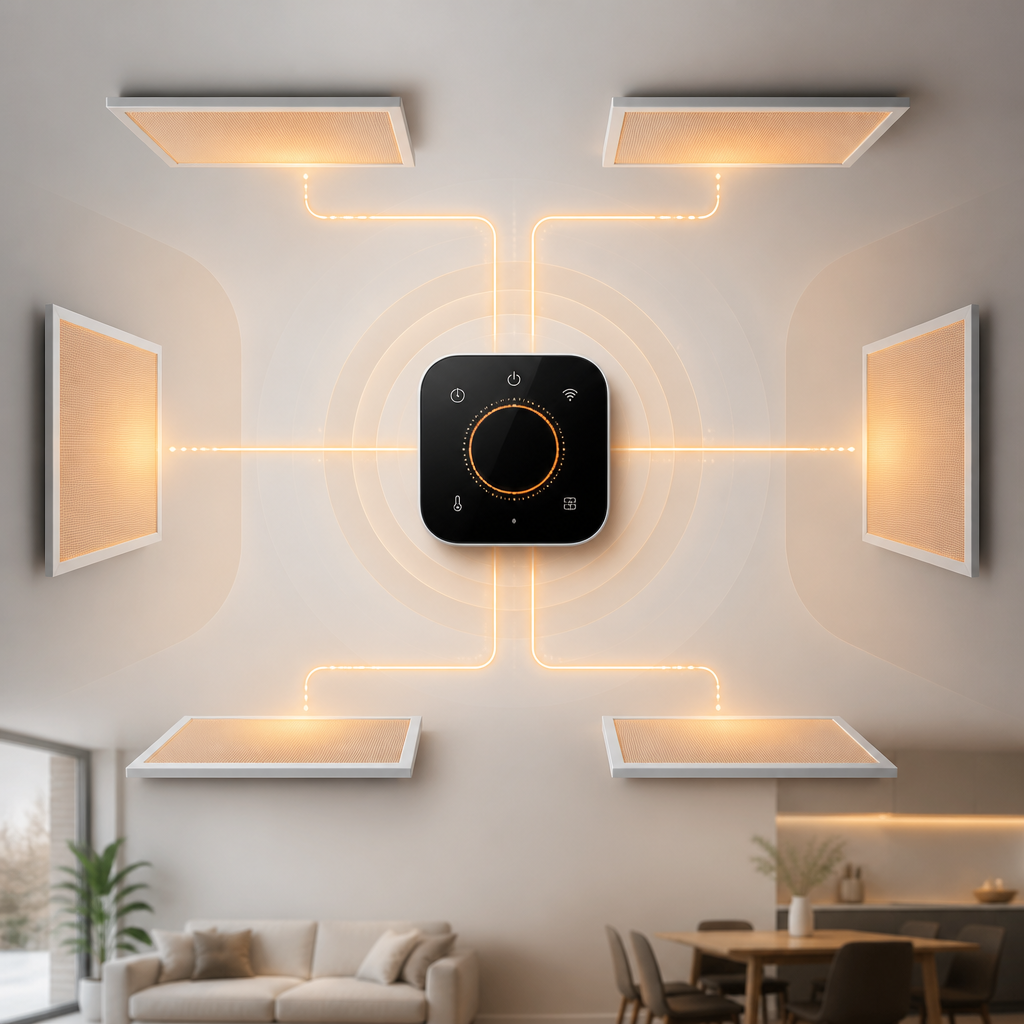
Multiple infrared heating panels can share one smart heating control system only when they are electrically compatible, remain within the calculated rating of the switching device and supply circuit, and belong to the same heating zone.
There are two different ways to interpret “one smart heating control system”:
1. One thermostat controlling several panels through a relay or contactor. This creates one genuine heating zone with one temperature sensor and one switching command.
2. Several smart panels grouped in an app. This provides shared schedules or commands, but the panels may still use separate sensors, timing logic and automation settings rather than operating as one synchronized thermostat zone.
Can multiple infrared heating panels run from one smart thermostat?
Yes, one smart thermostat can control multiple infrared panels when the panels use a compatible electrical supply and the thermostat-controlled switching arrangement is rated for the complete connected load.
A thermostat measures temperature at its sensor and calls for heat. When the panels are connected to the same switched output, relay or contactor, they follow that control signal as one zone. Panels connected to different outputs or controlled by separate smart modules can operate at different times even when they are grouped in the same app.
This arrangement suits a single room or open area with one temperature requirement. Rooms with different occupancy patterns, heat losses or target temperatures should use separate thermostats or independently switched zones.
What does one smart heating zone mean?
One smart heating zone means that every panel assigned to the same thermostat-controlled output responds to one temperature target and one control decision.
The thermostat should be installed in a representative location away from direct sunlight, exterior doors, drafts, cooking appliances and the direct radiant path of a panel. Its reading controls the entire group, so an unsuitable sensor location can make the whole zone cycle too early or too late.
Use one zone when:
- The panels heat one continuous room or area.
- Occupants need the same temperature target.
- The panels should operate on the same schedule.
- One thermostat location represents the area accurately.
Use separate zones when rooms need different temperatures, schedules or occupancy-based control. A bedroom, bathroom, hallway and home office normally benefit from independent controls rather than one shared sensor.
How many panels can one thermostat control?
The maximum panel count is the number of compatible panels whose combined electrical load can be switched safely by the control equipment and supply circuit.
There is no universal maximum number of panels. The limit is established by the following calculation and equipment ratings:
Current (A) = total panel wattage (W) ÷ supply voltage (V)
The switching device must be rated for at least the calculated load, with appropriate allowance and compliance with the device manufacturer’s switching, duty-cycle and installation requirements. The supply circuit, protective devices, conductors, isolator and enclosure must also be designed for the installation; the current calculation alone does not select those components.
How do I calculate the load for several panels?
Add the rated wattage of every panel in the zone and divide the total by the supply voltage.
The following examples use a 230V supply and show ideal nominal operating-current calculations:
| Heating-zone layout | Combined panel load | Nominal current at 230V | Nominal current at 120V |
|---|---|---|---|
| Two 300W panels | 600W | 2.61A | 5.00A |
| Three 600W panels | 1,800W | 7.83A | 15.00A |
| Four 500W panels | 2,000W | 8.70A | 16.67A |
| Four 800W panels | 3,200W | 13.91A | 26.67A |
| Four 1,200W panels | 4,800W | 20.87A | 40.00A |
Yandiya’s 2025 brochure lists smart-panel examples rated at 300W, 350W, 500W, 600W, 800W, 1,000W and 1,200W, with the brochure table using 230Vac and identifying rated power, output and amperage. That list should be treated as the range shown in that brochure, not as a universal statement that every model is available in every country or configuration. (yandiya.net)
A particular panel may also have a separate power-output figure from its rated electrical input. For example, Yandiya’s 600W glass-panel specification identifies a 600W power rating and a 220–240V operating range. (yandiya.net)
Do I need a relay or contactor?
Use a relay or contactor when the thermostat output is not designed to switch the full mains load of all connected panels.
The control architecture normally follows one of these patterns:
- Line-voltage thermostat: The thermostat switches the heater circuit directly when its contacts are rated for the complete connected load and switching duty.
- Low-voltage thermostat: The thermostat sends a low-power call for heat to a relay or contactor, which switches the mains supply to the panels.
- Smart-panel control: Each panel uses its own compatible smart module, and the app coordinates schedules or commands without necessarily creating one shared thermostat zone.
A relay or contactor must match the installation’s voltage, switching type, number of poles, phase arrangement, load type, duty cycle and control-signal requirements. The Resideo R841D1036/U is one example of a 24Vac-controlled electric-heater relay, but its specifications do not make it suitable for every infrared-panel installation. (customer.resideo.com)
Do not select a relay solely because its headline wattage appears higher than the panel total. Confirm its contact rating at the actual supply voltage, its suitability for the panel load, its control voltage, its switching behavior and its installation requirements.
Can Wi-Fi and Zigbee panels be grouped in one app?
Compatible panels can be grouped within a smart-home platform only when they use the same supported ecosystem, gateway or integration path and are approved for that control arrangement.
Yandiya’s 2025 brochure describes smart infrared panels using either Zigbee or Wi-Fi modules with Tuya software. (yandiya.net) Yandiya’s resource library also lists separate smart-control and thermostat documentation, so the exact product instructions should be checked for each panel and control device. (yandiya.net)
Wi-Fi and Zigbee are not automatically interchangeable:
- Wi-Fi panels usually connect directly to a wireless network or compatible cloud platform.
- Zigbee panels normally require a compatible Zigbee hub or gateway.
- Tuya compatibility does not by itself prove that two devices support the same group, thermostat, gateway or automation function.
- Mixed-protocol systems require confirmation of the specific panel model, module, hub, app and control function.
App grouping may send the same command to several panels, but it may not provide one shared temperature sensor, identical response times or truly synchronized switching. Use a wired thermostat and common relay or contactor when one sensor and one synchronized heating output are required.
Which control design should I choose?
Choose the control design according to whether the panels need one shared zone or individual addressability.
| Requirement | Recommended design |
|---|---|
| One room with one temperature target | One thermostat controlling a suitably rated relay, contactor or line-voltage output |
| Several panels on one electrical zone | One thermostat plus a contactor when the thermostat cannot switch the total load directly |
| Different rooms with different temperatures | Multiple thermostats and independently switched panel groups |
| Individual panel control and app access | Compatible smart panels with individual addressing and verified app or gateway support |
| Shared app schedules without one sensor | Grouped Wi-Fi or Zigbee panels in the same supported ecosystem |
| Mixed Wi-Fi, Zigbee and wired controls | Confirm protocol, gateway, thermostat, relay and panel compatibility before installation |
What should be checked before connecting several panels?
Confirm the complete electrical and control chain before connecting any panels to one smart system.
Panel and supply compatibility
- Confirm the voltage and frequency on every panel data sheet.
- Confirm whether the panels are intended for the same supply system.
- Add the rated wattage of all panels assigned to the zone.
- Calculate nominal current at the actual supply voltage.
- Account for the panel manufacturer’s specified current and operating characteristics.
Thermostat and switching compatibility
- Identify whether the thermostat switches line voltage or only a low-voltage control signal.
- Confirm the thermostat’s contact rating and switching method.
- Select a relay or contactor rated for the calculated load and intended duty cycle.
- Confirm voltage, phase, poles, isolation and control-coil requirements.
- Confirm that the panel manufacturer permits thermostat, relay or contactor control.
- Verify the exact panel model, thermostat model, smart module, gateway and app combination.
Installation requirements
- Design circuit protection for the complete heater circuit.
- Select cable size according to load, installation method, length, ambient conditions and applicable electrical rules.
- Provide suitable isolation and switching arrangements.
- Confirm earthing and bonding requirements for the equipment and enclosure.
- Consider inrush current and the relay or contactor’s resistive-load rating.
- Install the temperature sensor where it represents the occupied zone.
- Use a qualified electrician for design, installation, testing and verification.
Are all Yandiya panels automatically compatible with one controller?
No, Yandiya panels are not automatically interchangeable with every thermostat, relay, contactor, Wi-Fi system or Zigbee gateway.
A conventional panel may require an external thermostat and switching device, while a smart panel may contain an integrated Wi-Fi or Zigbee module. Panels with different voltages, internal controls, connectors or smart modules should not be mixed on one control output until the manufacturer’s documentation confirms compatibility.
Product categories such as aluminium panels, glass panels, mirrors and industrial heaters can also have different installation and operating requirements. An industrial tote heater should be treated as process-temperature equipment, with its thermostat settings, over-temperature protection and control method matched to the stored material and work environment.
Product descriptions should not be treated as evidence of certification for hospitals, regulated healthcare areas or clean rooms. Those applications require the relevant product documentation, certifications and project approvals.
Practical decision tree
1. Do all panels heat the same zone?
- Yes: Continue with one-zone control.
- No: Use separate thermostats or independently switched zones.
2. Are the panels electrically compatible?
- Yes: Add their rated wattages and calculate current.
- No or unclear: Do not connect them to one output until compatibility is confirmed.
3. Can the thermostat switch the calculated load?
- Yes: Use the thermostat only when its rating and installation instructions permit direct switching.
- No: Use a correctly specified relay or contactor.
4. Is individual panel addressability required?
- Yes: Use compatible smart panels and a verified app or gateway arrangement.
- No: A single thermostat and shared switching device usually provide the simpler one-zone design.
5. Are protocols being mixed?
- Yes: Confirm exact interoperability between the panels, hubs, thermostats and switching equipment.
- No: Follow the manufacturer’s pairing and installation documentation.
Closing recommendation
Use one thermostat and a correctly specified relay or contactor for multiple panels serving one zone, use separate thermostats for rooms with different comfort requirements, and use individually addressable smart panels when panel-level app control is essential. Professional electrical design is required whenever the installation involves mains switching, multiple circuits, low-voltage controls, mixed protocols, unusual loads or uncertainty about compatibility.
FAQ
What is the maximum number of infrared panels one thermostat can control?
The maximum number is the number of compatible panels whose combined calculated load remains within the ratings of the thermostat, relay or contactor, wiring and supply circuit; there is no universal panel-count limit.
What thermostat load rating do I need?
The thermostat or its switching device must be rated for at least the calculated combined load at the actual supply voltage, with the manufacturer’s required allowance and switching-duty requirements applied.
When is a relay or contactor required?
A relay or contactor is required when the thermostat switches only a low-voltage control signal or when its contacts are not rated to switch the full combined mains load of the panels.
Can Wi-Fi and Zigbee panels be grouped together?
Wi-Fi and Zigbee panels can be grouped only when the specific panels, gateway, app and integration support that arrangement; sharing a brand or app does not automatically make mixed protocols interoperable.
Do panels in separate rooms need separate thermostats?
Panels in separate rooms need separate thermostats or independently controlled zones when those rooms require different temperatures, schedules or occupancy-based operation.
Will grouped smart panels turn on and off at exactly the same time?
Panels turn on and off together only when they share the same switched output and control logic, while app-grouped panels may show timing, sensor or automation differences.
Sources
- Yandiya Technology 2025 Brochure (yandiya.net)
- Yandiya 600W Glass Black Technical Specification (yandiya.net)
- Yandiya Product Resources and Smart-Control Documentation (yandiya.net)
- Yandiya Wave Controlled Infrared Mirror Product Specifications (yandiya.net)
- Resideo R841D1036/U Electric Heater Relay Documentation (customer.resideo.com)
> Installation note: Electrical heating systems must be designed, installed, isolated, tested and verified by a qualified electrician in accordance with the applicable local electrical regulations, circuit-protection rules and panel, thermostat, relay and contactor instructions. Supply voltage, cable sizing, earthing, inrush characteristics, switching method and regional product approvals must be confirmed for the actual installation.
References
- https://support.sinopetech.com/en/power-calculation?sku_origine=TH1133WF-TH1134WF
- https://support.sinopetech.com/en/power-calculation
- https://support.herschel-infrared.com/hc/en-gb/articles/9843585286429-Can-I-pair-multiple-heaters-to-a-thermostat
FAQ
What is the maximum number of infrared panels one thermostat can control?
The maximum number is the number of compatible panels whose combined calculated load remains within the ratings of the thermostat, relay or contactor, wiring and supply circuit; there is no universal panel-count limit.
What thermostat load rating do I need?
The thermostat or its switching device must be rated for at least the calculated combined load at the actual supply voltage, with the manufacturer’s required allowance and switching-duty requirements applied.
When is a relay or contactor required?
A relay or contactor is required when the thermostat switches only a low-voltage control signal or when its contacts are not rated to switch the full combined mains load of the panels.
Can Wi-Fi and Zigbee panels be grouped together?
Wi-Fi and Zigbee panels can be grouped only when the specific panels, gateway, app and integration support that arrangement; sharing a brand or app does not automatically make mixed protocols interoperable.
Do panels in separate rooms need separate thermostats?
Panels in separate rooms need separate thermostats or independently controlled zones when those rooms require different temperatures, schedules or occupancy-based operation.
Will grouped smart panels turn on and off at exactly the same time?
Panels turn on and off together only when they share the same switched output and control logic, while app-grouped panels may show timing, sensor or automation differences.
About the author
Yandiya Technology HK Ltd, a global leader in manufacturing infrared heating, is a beacon of innovation and efficiency. We have pioneered the development and application of infrared heating technology, transforming the way people heat their homes and businesses across the world.