 Yandiya Technology HK Ltd
Yandiya Technology HK Ltd › Blog › How Much Electricity Do Far Infrared Heating Panels Typically Use?
← All articlesHow Much Electricity Do Far Infrared Heating Panels Typically Use?

Key takeaways
- Electricity use equals panel wattage divided by 1,000, multiplied by active operating hours.
- A 500 W panel uses 0.5 kWh per active hour, while a 1,200 W panel uses 1.2 kWh per active hour.
- Eight hours of continuous active operation is a maximum-runtime calculation, not a typical household-use assumption.
- Thermostat control reduces consumption when it switches the panel off or lowers its output.
- Whole-home operating cost depends on heat loss, zoning, control behavior, installation, and electricity tariffs.
- Replacing a gas boiler with infrared panels addresses space heating only and requires room-by-room sizing and electrical-capacity assessment.
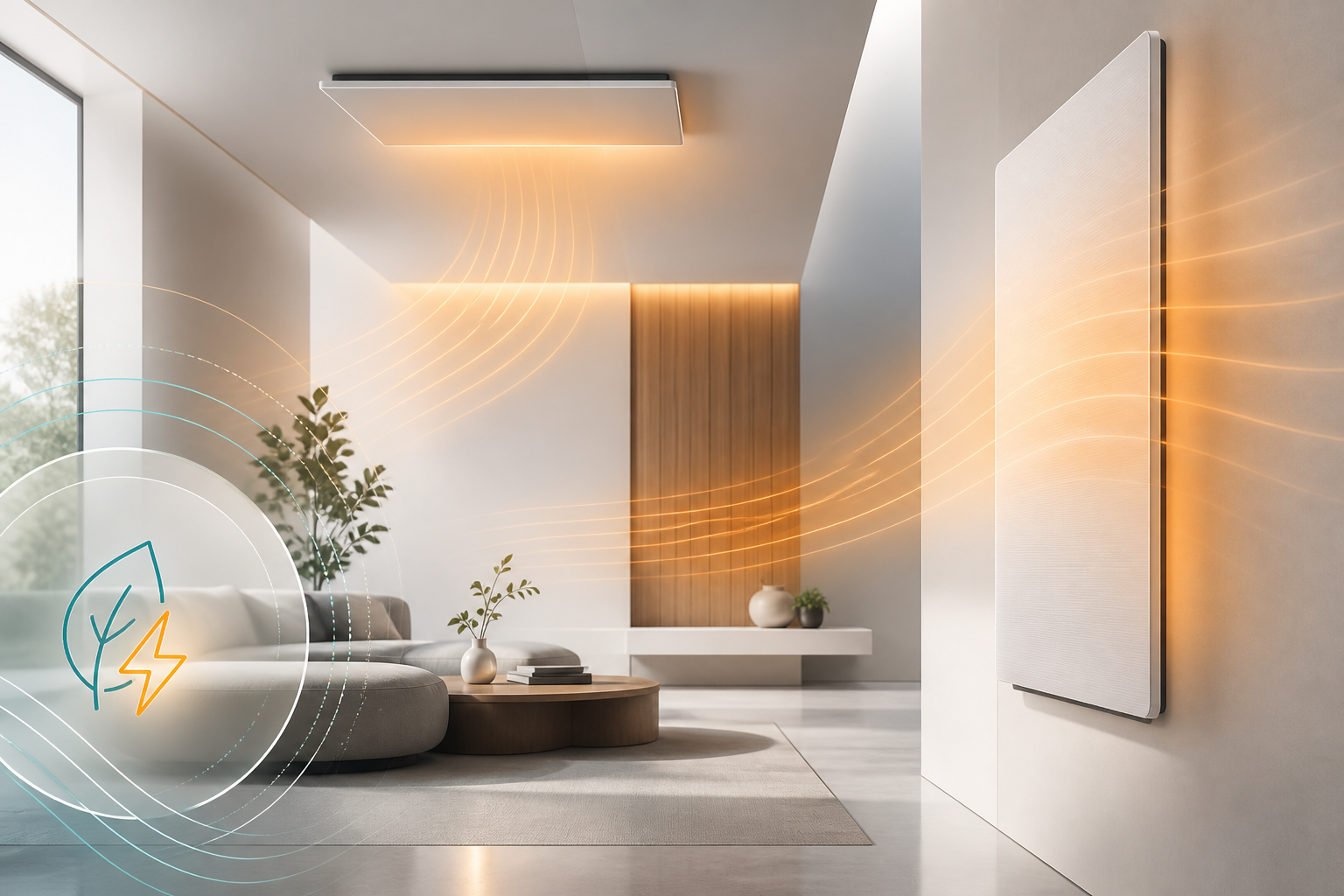
Far infrared heating panel electricity use is determined by the panel’s rated wattage and active runtime: a 500 W panel uses 0.5 kWh per hour while operating at its rated input, while panels in the 350 W to 1,200 W range use 0.35 to 1.2 kWh per active hour.
How much electricity does a far infrared heating panel use per hour?
A far infrared heating panel uses its rated wattage divided by 1,000 in kilowatt-hours for each hour it operates at that input level.
Electricity used (kWh) = rated wattage ÷ 1,000 × active operating hours
Examples:
- A 350 W panel uses 0.35 kWh per active hour.
- A 500 W panel uses 0.50 kWh per active hour.
- An 800 W panel uses 0.80 kWh per active hour.
- A 1,200 W panel uses 1.20 kWh per active hour.
Kilowatt-hours are the units recorded on an electricity bill. Rated wattage describes the panel’s electrical input when it operates at that rating; it does not by itself show how many hours the panel will operate during a day.
Rated input, active runtime, and total consumption
A panel’s rated electrical input is its operating demand at the stated wattage. Active runtime is the time the heating element operates. Thermostat or control electricity covers the power used by thermostats, receivers, timers, or other control equipment. Total system consumption is the active panel electricity plus control and standby electricity.
How many kWh do common infrared panel sizes use each day?
A 350 W to 1,200 W infrared panel uses 2.8 to 9.6 kWh during eight hours of continuous active operation.
The following table is a maximum-runtime scenario showing eight full active heating hours per day for 30 days. It is a calculation example rather than a typical household-use profile.
| Panel rated wattage | Electricity used per active hour | Electricity used in 8 active hours | Electricity used in 30 days at 8 active hours per day |
|---|---|---|---|
| 350 W | 0.35 kWh | 2.8 kWh | 84 kWh |
| 500 W | 0.50 kWh | 4.0 kWh | 120 kWh |
| 600 W | 0.60 kWh | 4.8 kWh | 144 kWh |
| 800 W | 0.80 kWh | 6.4 kWh | 192 kWh |
| 1,200 W | 1.20 kWh | 9.6 kWh | 288 kWh |
Calculation note: estimating real-world use
Use this formula for a practical estimate:
Estimated monthly electricity use = panel wattage ÷ 1,000 × average active hours per day × number of days
For example, a 500 W panel operating for an average of four active hours per day uses:
0.5 kW × 4 hours × 30 days = 60 kWh per month
A 50% duty-cycle example is an illustration only: a 500 W panel operating for four active hours within an eight-hour scheduled period uses about 2 kWh that day. Panels do not generally operate at a fixed 50% duty cycle; actual active time is determined by the controls and heating demand.
Does thermostat control reduce infrared heating panel electricity consumption?
Thermostat control reduces electricity use when the control system switches the panel off or lowers its output after the room reaches the target temperature.
A scheduled heating period is not necessarily the same as active heating time. For example, a panel may be scheduled to provide heat for eight hours but operate for only part of that period as the control system responds to room temperature.
Actual consumption also includes any electricity used by thermostats, receivers, timers, smart controls, or standby functions. The amount varies by the equipment used and should be added to the panel calculation when precise system consumption is required.
Active runtime is influenced by room insulation, outdoor temperature, room size, ventilation, occupancy, desired temperature, panel placement, and heat loss. Zoning can reduce consumption by allowing unused rooms to remain at a lower temperature or without active heating.
Are infrared panels cheaper to run than other electric heaters?
Infrared panels and other electric resistance heaters use broadly similar amounts of electricity to deliver the same amount of heat because both convert electrical energy into heat at the point of use.
The difference in whole-home operating cost comes from how the system delivers and controls heat. Infrared panels can support room-by-room zoning and targeted radiant comfort, while other electric heaters may distribute heat through air movement or localized convection.
Whole-home cost is determined by:
- The building’s heat loss.
- The number of rooms being heated.
- Thermostat settings and control behavior.
- Active runtime and zoning.
- Insulation, draughts, and ventilation.
- Installation and maintenance requirements.
- Electricity tariffs and any time-of-use pricing.
Infrared panels do not use substantially fewer watts than other resistance heaters simply because they emit infrared radiation. The relevant electricity-use calculation remains the panel’s electrical input multiplied by active runtime.
What does a panel’s efficiency percentage mean?
A product specification percentage should be used for electricity budgeting only when it clearly defines the measured quantity and test method; a percentage describing radiant output, emissivity, heat-transfer performance, or conversion efficiency is not automatically a reduction in the panel’s electrical consumption.
For electricity estimates, use the panel’s rated electrical input and operating time. A 500 W panel does not become a 10 W appliance because a specification describes a high energy-transfer or radiant-performance percentage.
Which rated wattage should be used to estimate panel electricity use?
Use the panel’s stated electrical input or power-consumption figure for electricity estimates, and use the higher clearly defined figure when a specification lists separate nominal and maximum values.
Product specifications can use terms such as rated power, power rating, input power, or maximum power differently. These terms should not be treated as interchangeable unless the documentation defines them consistently.
For a system with two 500 W panels, the combined rated input is 1,000 W when both panels operate at that input level, equal to 1 kWh per active hour. The number of panels does not change the calculation; the combined electrical input does.
Can smaller infrared products provide low-cost supplementary warmth?
Lower-wattage infrared products use less electricity per active hour, but they generally provide localized or supplementary warmth rather than the full heating load for an entire room.
Examples include:
- A 70 W product using 0.07 kWh per active hour.
- A 120 W towel rail using 0.12 kWh per active hour.
For full-room heating, select the panel capacity from the room’s heat loss, dimensions, insulation, intended temperature, and use pattern. A towel rail, mirror heater, or compact infrared product should not be counted as a full replacement for a room-heating panel unless its output has been sized for that purpose.
Can infrared panels replace a gas boiler?
Infrared panels can replace the space-heating service of a gas boiler in an all-electric design when the installed panel capacity meets the building’s room-by-room heat demand and the property has sufficient electrical capacity.
This is not a one-for-one appliance swap. Infrared panels provide heat directly in individual rooms, while a gas boiler may supply radiators, underfloor heating, and domestic hot water. Installing infrared panels does not automatically replace hot-water production, pipework, radiators, or the whole-home heating capacity provided by the boiler.
A replacement design should assess:
- Room-by-room heat loss.
- Required panel wattage and placement.
- The number of zones and thermostats.
- Electrical supply and circuit capacity.
- Domestic hot-water requirements.
- Insulation and ventilation.
- Desired schedules and room temperatures.
FAQ
How much does a 500 W infrared heating panel cost per hour?
A 500 W infrared panel uses 0.5 kWh per active hour, so its hourly electricity cost equals 0.5 × your electricity tariff per kWh.
For example, at a tariff of $0.20 per kWh, the panel costs $0.10 per active hour. Control and standby electricity can add a small additional amount.
How many infrared panels are needed for one room?
The number of panels needed for a room is determined by the room’s calculated heat loss divided by the useful output of the selected panels.
A proper estimate uses room dimensions, insulation, windows, ventilation, climate, desired temperature, and whether adjacent rooms are heated. Wattage alone is not a reliable room-sizing rule.
Does panel wattage equal heat output?
Panel wattage describes electrical input, while a resistance infrared panel’s useful heat output is approximately the same order as its electrical input at the point of use.
Radiant distribution affects where occupants and surfaces feel warmth, but it does not make a 500 W panel consume less electricity than its electrical input indicates.
How can I estimate monthly infrared heating-panel use?
Estimate monthly use by multiplying the panel’s kilowatt rating by its average active hours per day and the number of days in the billing period.
Monthly use = wattage ÷ 1,000 × active hours per day × billing-period days
For multiple panels, add their wattages before applying the formula, or calculate each panel separately and add the results.
Does a thermostat always reduce electricity use?
A thermostat reduces electricity use when it switches the panel off or reduces its output instead of allowing full-rated operation throughout the scheduled period.
The result depends on the control method, temperature settings, room heat loss, and the electricity used by connected controls and standby functions.
Are infrared panels suitable for bathroom heating?
Infrared panels are suitable for bathroom heating when the selected equipment is rated for the installation location and its output matches the bathroom’s heat requirement.
Compact mirror heaters and towel rails provide localized warmth, while a dedicated room-heating panel supplies the main heating load for a larger or colder bathroom.
Sources
- Yandiya 350 W Mirror Panel Specification
- Yandiya 500 W Aluminium White Panel Specification
- Yandiya 600 W Glass Black Panel Specification
- Yandiya 800 W Aluminium White Panel Specification
- Yandiya Product Brochure
- Yandiya Technology 2025 Brochure
- EECA electric-heater guidance
Disclaimer
Electricity costs equal kilowatt-hours consumed multiplied by the applicable electricity tariff. Panel sizing, bathroom installations, electrical circuits, and whole-home heating replacements should be assessed in accordance with local requirements by appropriately qualified professionals.
FAQ
How much does a 500 W infrared heating panel cost per hour?
A 500 W infrared panel uses 0.5 kWh per active hour, so its hourly electricity cost equals 0.5 multiplied by your electricity tariff per kWh.
How many infrared panels are needed for one room?
The number of panels needed for a room is determined by the room’s calculated heat loss divided by the useful output of the selected panels.
Does panel wattage equal heat output?
Panel wattage describes electrical input, while a resistance infrared panel’s useful heat output is approximately the same order as its electrical input at the point of use.
How can I estimate monthly infrared heating-panel use?
Estimate monthly use by multiplying the panel’s kilowatt rating by its average active hours per day and the number of days in the billing period.
Does a thermostat always reduce electricity use?
A thermostat reduces electricity use when it switches the panel off or reduces its output instead of allowing full-rated operation throughout the scheduled period.
Are infrared panels suitable for bathroom heating?
Infrared panels are suitable for bathroom heating when the selected equipment is rated for the installation location and its output matches the bathroom’s heat requirement.
About the author
Yandiya Technology HK Ltd, a global leader in manufacturing infrared heating, is a beacon of innovation and efficiency. We have pioneered the development and application of infrared heating technology, transforming the way people heat their homes and businesses across the world.