 Yandiya Technology HK Ltd
Yandiya Technology HK Ltd › Blog › What Should I Consider When Choosing Infrared Heating Panels for an Outdoor Application?
← All articlesWhat Should I Consider When Choosing Infrared Heating Panels for an Outdoor Application?

Key takeaways
- Choose a purpose-built outdoor model rather than adapting an indoor infrared panel.
- Verify the exact IP rating, voltage, wattage, current, certification and installation manual.
- Treat IP65 as dust and water-jet protection, not proof of immersion, freeze-thaw or salt-air suitability.
- Size heating around occupied radiant zones, mounting conditions and wind exposure instead of generic floor area.
- Confirm U.S. voltage compatibility before ordering because a 220–240V model is not directly compatible with a typical 120V receptacle.
- Use zoning, timers and occupancy controls to reduce runtime in unoccupied areas.
- Engineer mounting height, clearances, tilt, wind stability, cable routing and accidental-contact protection.
- Plan corrosion control and maintenance for coastal, pool, restaurant and commercial installations.
- Use the continuous and duty-cycle formulas to estimate operating cost from actual wattage, hours and tariff.
- Follow the exact installation manual and adopted local code, with qualified professional support for fixed outdoor electrical work.
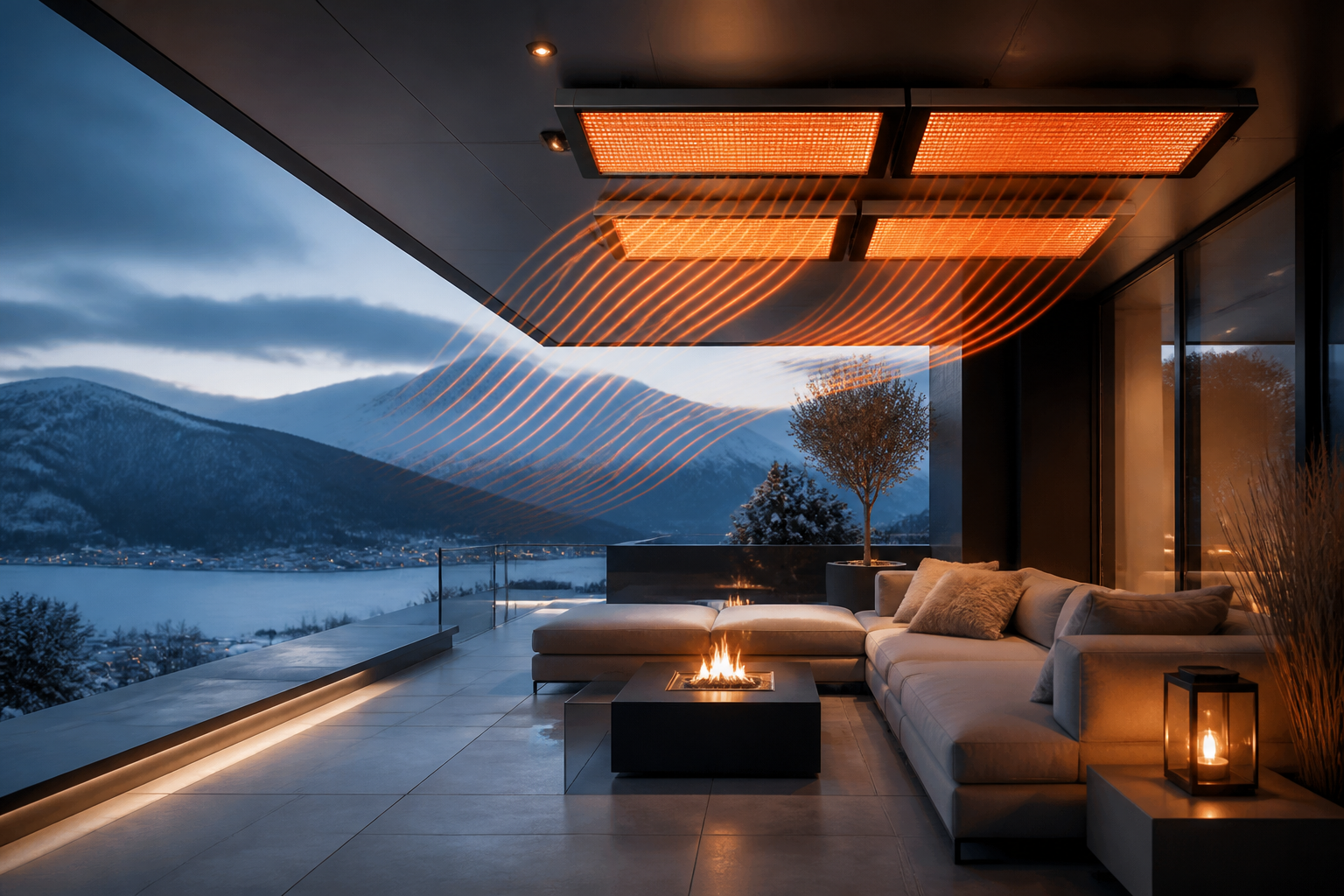
Choose a purpose-built outdoor infrared heater, verify its IP rating and voltage, size it around occupied radiant zones, and confirm mounting, clearance and electrical safety before buying.
For homeowners, restaurants, hotels and facility managers, the right choice depends on exposure, seating layout, wind, corrosion risk, control requirements and the electrical service available at the site.
Is an indoor infrared heating panel suitable for outdoor use?
An indoor infrared panel is unsuitable for exposed outdoor installation unless its exact model is specifically approved for outdoor use.
- Indoor models may lack protection against rain, condensation, dust, temperature changes and outdoor mounting stresses.
- A covered patio is still an outdoor environment because wind-driven rain, humidity and condensation can reach the heater and its connections.
- The published Yandiya indoor aluminium-panel specifications include IP41 models, while the Zero outdoor range is listed at IP65.
- Choose a model whose installation manual expressly permits the intended location, mounting method and exposure level.
What does an IP rating tell me about outdoor suitability?
IP65 provides dust protection and protection against water jets, but it does not certify a heater for immersion, permanent rain exposure, freeze-thaw cycling or salt-air corrosion.
The IP code describes enclosure protection under defined test conditions; it does not replace a site assessment. Before installation, consider:
- Direct and wind-driven rain.
- Condensation and repeated temperature changes.
- Snow accumulation, ice and freeze-thaw conditions.
- Drainage and the possibility of standing water.
- Salt air near the coast.
- Chlorine, pool chemicals, grease, smoke and cleaning products.
- Whether the power connection, controller and junction box have their own suitable outdoor ratings.
Why does radiant heating work well in outdoor spaces?
Infrared heating works outdoors by delivering radiant energy directly to people and nearby surfaces instead of depending on heated air remaining in place.
Plan the installation around the people who need warmth rather than the entire cubic volume of the patio or terrace. A heater needs a clear radiant path to diners, guests or staff, and screens, columns, planters, furniture and changing seating layouts can create cold spots.
For restaurants and hotels, divide the terrace into independently controlled zones. Zoning can reduce runtime for empty tables, unused lounge areas or service areas without requiring the entire installation to operate at once.
How much outdoor area can an infrared heater cover?
Outdoor infrared coverage should be sized by occupied radiant zones and verified against mounting height, wind exposure, shelter, target comfort level and the manufacturer’s test conditions.
Published area figures are not universal room-heating ratings. Treat them as model-specific planning data only when the manufacturer identifies the relevant mounting height, orientation, shelter and comfort assumptions; otherwise, use a qualified designer or installer to calculate the layout.
Start with:
1. The number and position of seats or standing locations.
2. The distance between the heater and occupants.
3. The amount of roof or wall shelter.
4. Prevailing wind and the site’s most exposed directions.
5. Whether the goal is comfort for seated diners, standing guests or staff performing active work.
6. Whether one broad zone or several smaller zones will be easier to control.
Published Zero range electrical figures
The Yandiya Zero range lists five power options and the following operating currents at its stated 220–240V AC supply:
| Heater rating | Listed current | Best use as a starting point |
|---|---|---|
| 1,000W | 4.35A | Compact sheltered seating zone |
| 1,500W | 6.52A | Small residential or hospitality zone |
| 1,800W | 7.83A | Medium seating or standing zone |
| 2,400W | 10.43A | Larger dining or lounge zone |
| 3,200W | 13.91A | High-load commercial zone |
These electrical figures help with circuit planning; they do not establish a guaranteed outdoor comfort area.
What electrical supply does an outdoor infrared heater need?
An outdoor infrared heater must match the site’s voltage, circuit capacity, protection, plug or hard-wiring arrangement and total simultaneous load.
The published Yandiya Zero specification is 220–240V AC, which is not directly compatible with a typical U.S. 120V patio receptacle; U.S. buyers must confirm that the exact model is approved for the available service before ordering.
For multiple heaters:
- Add the wattage of every unit that may operate simultaneously.
- Confirm the circuit voltage, amperage, conductor size and overcurrent protection.
- Use weather-resistant outdoor boxes, covers, disconnects and connection methods appropriate to the installation.
- Do not assume an adapter or transformer makes a 220–240V heater suitable for a 120V circuit.
- Treat pool-adjacent, commercial and permanently wired installations as site-specific electrical designs.
In the United States, GFCI requirements depend on the location, equipment, circuit and jurisdiction; outdoor receptacles and equipment near water commonly fall within GFCI rules, so the applicable adopted code and a qualified electrician should determine the final arrangement.
How do I calculate an outdoor infrared heater’s running cost?
Running cost equals heater power in kilowatts multiplied by operating hours and the electricity price per kilowatt-hour.
Use the continuous-operation formula:
Running cost = heater kW × operating hours × electricity price per kWh
For example, a 2,400W heater uses 2.4kWh in one hour, and an example tariff of $0.20/kWh produces a direct energy cost of $0.48 for that hour.
For duty-cycle operation, use:
Running cost = heater kW × scheduled hours × duty cycle × electricity price per kWh
Four 1,500W heaters have a combined load of 6kW. At an example tariff of $0.20/kWh, three scheduled hours at a 50% duty cycle cost $1.80 in direct energy use rather than $3.60 at continuous operation.
Timers, thermostatic cycling, occupancy controls and zoning can reduce actual runtime, but they do not change the heater’s rated power when it is operating.
Which controls are useful for outdoor infrared heating?
Use independently controlled zones, timers or occupancy-based controls to avoid heating areas that are empty.
Useful control options include:
- Manual switching for simple residential patios.
- Remote controls for individual heaters or small groups.
- Timers for predictable restaurant or event schedules.
- Thermostatic controls where the equipment supports them.
- Occupancy controls for changing commercial use patterns.
- Building-management integration for hotels, venues and facility portfolios.
The published Zero outdoor specification lists remote-control availability and a warm-up time under five seconds. Use only control hardware approved for the exact heater, voltage and outdoor installation.
How is panel-style infrared heating different from tube, quartz and halogen heaters?
Panel-style far-infrared heaters suit fixed, directional zones where quiet operation, a low-profile appearance and controlled radiant coverage matter more than portability.
Consider another emitter type when the site requires:
- Stronger wind tolerance from a higher-intensity emitter.
- A narrower beam or longer throw across an exposed terrace.
- Fast repositioning between changing event layouts.
- A portable freestanding installation.
- High radiant output from a compact fixture.
Panel, carbon-fiber, quartz and halogen products differ in surface temperature, wavelength, controls, mounting requirements and light output, so compare complete product specifications rather than relying on the word “infrared.”
Where should an outdoor infrared heater be mounted?
Mount the heater at the manufacturer’s specified height and orientation with documented clearances, stable support, controlled cable routing and protection from accidental contact.
Before purchase, obtain the exact installation manual and confirm:
- Minimum and maximum mounting height.
- Required spacing from ceilings, walls and adjacent equipment.
- Clearance from combustible materials, fabrics, umbrellas, decorations and foliage.
- Permitted tilt angle and orientation.
- Bracket load rating and substrate suitability.
- Wind-load stability for the structure and mounting hardware.
- Protection against impact, tampering and accidental contact.
- Access for inspection, cleaning and replacement.
“Beyond reach” is not a complete safety standard because seated guests, children, ladders, furniture and wind-blown objects can change the contact risk. The heater’s surface temperature and the manual’s clearance requirements must control the design.
Are tripods suitable for outdoor infrared heaters?
A tripod is suitable only when the product instructions permit temporary outdoor mounting and the stand can remain stable under the site’s wind, impact and cable conditions.
Check:
- The manufacturer’s permitted tripod or stand configuration.
- Maximum operating wind conditions, if specified.
- Base width, ballast and tip-over resistance.
- The risk of guests or staff striking the stand.
- Cable routing that prevents trip hazards and connector strain.
- Whether the heater must be removed during high winds, storms or site closure.
- Protection against unauthorized movement or tampering.
A tripod can provide layout flexibility, but a fixed wall or ceiling installation is usually more appropriate for permanent hospitality or commercial use.
What should commercial and coastal installations include?
Commercial and coastal installations need corrosion-resistant hardware, maintainable mounting, protected controls, documented inspection procedures and warranty terms that cover the exact model and operating environment.
Commercial sites
Restaurants, hotels, resorts and venues should plan for:
- Separate heating zones for tables, lounges, queues and staff areas.
- Controls that match opening hours and occupancy patterns.
- Secure mounting that resists impact and unauthorized adjustment.
- Safe access for cleaning and maintenance.
- Cable protection in public circulation areas.
- Records of inspections, repairs and control settings.
- Warranty coverage for commercial operation rather than residential use only.
Coastal sites
Salt air accelerates corrosion of exposed metals and electrical hardware. Select corrosion-resistant brackets and fasteners, keep connections protected, wash away salt deposits using the method permitted by the manual, and inspect mounting points, seals and cable entries regularly.
Pool and food-service areas
Pool chemicals, grease, smoke, detergents and airborne debris can degrade finishes, seals and hardware. Keep the heater away from chemical spray, cooking exhaust and pressure-washing paths, and select equipment and enclosures suited to the actual exposure.
Selection matrix
| Installation type | Starting priority | Voltage and controls | Mounting | Maintenance focus |
|---|---|---|---|---|
| Sheltered residential patio | Outdoor-rated enclosure, quiet operation and simple zoning | Match household service; remote or timer control | Fixed wall or ceiling mount | Clean vents and inspect connections seasonally |
| Exposed terrace | Wind-aware radiant layout and robust mounting | Use separately switched zones | Fixed mounting with engineered support | Inspect after storms and check movement or damage |
| Coastal site | Corrosion resistance and protected connections | Use controls rated for the environment | Stainless or otherwise corrosion-resistant hardware where specified | Remove salt deposits and inspect seals and fasteners |
| Pool area | Chemical exposure, wet-location design and GFCI planning | Site-specific electrical design and protected controls | Keep clear of splash, spray and maintenance routes | Inspect for chemical residue, corrosion and water ingress |
| Commercial venue | Zone control, tamper resistance and serviceability | Timer, remote, occupancy or building-management integration | Permanent structure-mounted installation | Formal inspection, cleaning and warranty records |
What should I check before ordering an outdoor infrared heater?
Before ordering, verify the exact model’s outdoor rating, electrical compatibility, mounting instructions, controls, certifications, warranty and suitability for the site’s wind and corrosion exposure.
Verify before buying
- Outdoor approval for the exact model.
- IP rating and the environmental limits stated in the manual.
- Voltage, frequency, wattage and operating current.
- Compatibility with the destination country and available electrical service.
- Required certification or listing for the installation market.
- Published mounting methods, height, tilt and clearances.
- Control options and outdoor suitability of the controller.
- Site-specific radiant layout rather than a generic room-area assumption.
- Commercial warranty terms and replacement-part support.
- Coastal, pool, grease, smoke and cleaning-chemical exposure limits.
Verify before installing
- Circuit capacity for the total simultaneous load.
- GFCI and weatherproofing requirements under the adopted local code.
- Mounting-substrate strength and wind stability.
- Clearance from combustibles and public contact.
- Cable routing, strain relief and trip protection.
- Drainage, condensation and freeze-thaw exposure.
- Safe access for inspection and cleaning.
- Emergency isolation and maintenance procedures.
- Compliance with the exact installation manual.
FAQ
What IP rating should an outdoor infrared heater have?
A purpose-built outdoor heater should have an IP rating appropriate to its exposure, with IP65 providing dust protection and water-jet resistance without covering immersion, condensation, freeze-thaw or salt-air risks.
Can an IP65 heater stay in the rain?
An IP65 heater resists dust and water jets, but permanent outdoor placement still requires the manufacturer’s approval for rainfall, condensation, drainage, mounting orientation and corrosion exposure.
Does wind stop infrared heating from working?
Wind does not remove the direct radiant-heating principle, but it increases occupant heat loss and can reduce comfort, so exposed sites need tighter zone planning, accurate aiming and secure mounting.
Is a 120V supply compatible with a 220–240V outdoor heater?
A 120V supply is not directly compatible with a heater specified only for 220–240V AC, and the exact model and installation must be approved for the available service.
Do outdoor infrared heaters need GFCI protection?
Outdoor and water-adjacent installations commonly require GFCI protection in the United States, with the final requirement determined by the adopted code, location, equipment and qualified electrical design.
How high should an outdoor infrared panel be mounted?
Mounting height must follow the exact product manual because safe height, clearance, tilt, surface temperature and radiant coverage vary by model.
Can I use the manufacturer’s coverage area as a guarantee?
A published coverage area is a model-specific planning figure rather than a universal guarantee because mounting height, shelter, wind, layout and comfort expectations change the result.
How can I reduce running costs?
Use the heater’s rated wattage with the actual electricity tariff and reduce scheduled runtime through zoning, timers, thermostatic cycling or occupancy controls.
Are infrared heaters suitable for coastal locations?
Infrared heaters can be used at coastal sites when the exact model, hardware, electrical connections and maintenance plan are suitable for salt-air corrosion.
Conclusion
The best outdoor infrared panel is the one that matches the site rather than the one with the largest headline wattage or coverage figure. Choose an outdoor-purpose model, confirm IP and voltage compatibility early, design around occupied radiant zones, and make mounting, wind, corrosion, controls and electrical protection part of the purchase decision.
Sources
- Yandiya Zero Outdoor Heaters — published Zero range power options, operating currents, 220–240V AC supply, IP65 rating, up to 90% efficiency, warm-up time under five seconds, remote-control availability, mounting options, warranty and manufacturer-listed coverage figures. (yandiya.net)
- Yandiya IH500-WM technical product page — product-specific indoor panel information; page availability should be checked directly before publication.
- Yandiya 500W Aluminium White datasheet — product-specific indoor panel specifications; the supplied URL returned an unavailable document during review.
- ASHRAE Handbook: Radiant Heating and Cooling — background on radiant heating principles.
- NFPA 70/National Electrical Code material on GFCI protection — adopted-code context for GFCI requirements, including outdoor locations. (docinfofiles.nfpa.org)
- U.S. Consumer Product Safety Commission GFCI fact sheet — U.S. consumer guidance on GFCI protection near outdoor and water-exposed electrical equipment. (cpsc.gov)
- U.S. Consumer Product Safety Commission extension-cord guidance — outdoor extension-cord construction and electrical shock or fire hazards. (cpsc.gov)
- UL Solutions environmental simulation and ingress-protection overview — explanation of IP water and dust testing and its relationship to environmental testing. (ul.com)
> Installation and code note: Follow the exact heater installation manual and the applicable adopted electrical, fire and building codes. General guidance in this article is not a substitute for site-specific design, certification review or installation by a qualified electrician or other competent professional.
References
- https://yandiya.net/dload/tech-specs/800w-Aluminium-White.pdf
- https://www.ledvance.com/10_LEDVANCE_only/asset-303451_342330_Technical_application_guide_-_IP_codes_in_accordance_with_IEC_60529_GB.pdf
- https://www.yandiya.net/product/ih500-wms
FAQ
What IP rating should an outdoor infrared heater have?
A purpose-built outdoor heater should have an IP rating appropriate to its exposure, with IP65 providing dust protection and water-jet resistance without covering immersion, condensation, freeze-thaw or salt-air risks.
Can an IP65 heater stay in the rain?
An IP65 heater resists dust and water jets, but permanent outdoor placement still requires the manufacturer’s approval for rainfall, condensation, drainage, mounting orientation and corrosion exposure.
Does wind stop infrared heating from working?
Wind does not remove the direct radiant-heating principle, but it increases occupant heat loss and can reduce comfort, so exposed sites need tighter zone planning, accurate aiming and secure mounting.
Is a 120V supply compatible with a 220–240V outdoor heater?
A 120V supply is not directly compatible with a heater specified only for 220–240V AC, and the exact model and installation must be approved for the available service.
Do outdoor infrared heaters need GFCI protection?
Outdoor and water-adjacent installations commonly require GFCI protection in the United States, with the final requirement determined by the adopted code, location, equipment and qualified electrical design.
How high should an outdoor infrared panel be mounted?
Mounting height must follow the exact product manual because safe height, clearance, tilt, surface temperature and radiant coverage vary by model.
How can I reduce running costs?
Use the heater’s rated wattage with the actual electricity tariff and reduce scheduled runtime through zoning, timers, thermostatic cycling or occupancy controls.
Are infrared heaters suitable for coastal locations?
Infrared heaters can be used at coastal sites when the exact model, hardware, electrical connections and maintenance plan are suitable for salt-air corrosion.
About the author
Yandiya Technology HK Ltd, a global leader in manufacturing infrared heating, is a beacon of innovation and efficiency. We have pioneered the development and application of infrared heating technology, transforming the way people heat their homes and businesses across the world.