 Yandiya Technology HK Ltd
Yandiya Technology HK Ltd › Blog › Are Yandiya Heating Panels Compatible With a WiFi Thermostat?
← All articlesAre Yandiya Heating Panels Compatible With a WiFi Thermostat?

Key takeaways
- Yandiya’s documented Smart Home Zigbee/Wi‑Fi infrared panel range supports WiFi thermostat control.
- The thermostat normally operates through a compatible relay, contactor, or integrated smart-control module.
- Tuya compatibility does not by itself prove that every Yandiya panel supports independent zones.
- Nest and ecobee compatibility depends on the exact model, output protocol, power method, and required interface.
- The switching device must be sized for the combined wattage of every panel in the zone.
- Mains-voltage installation and commissioning should be completed by a qualified electrician.
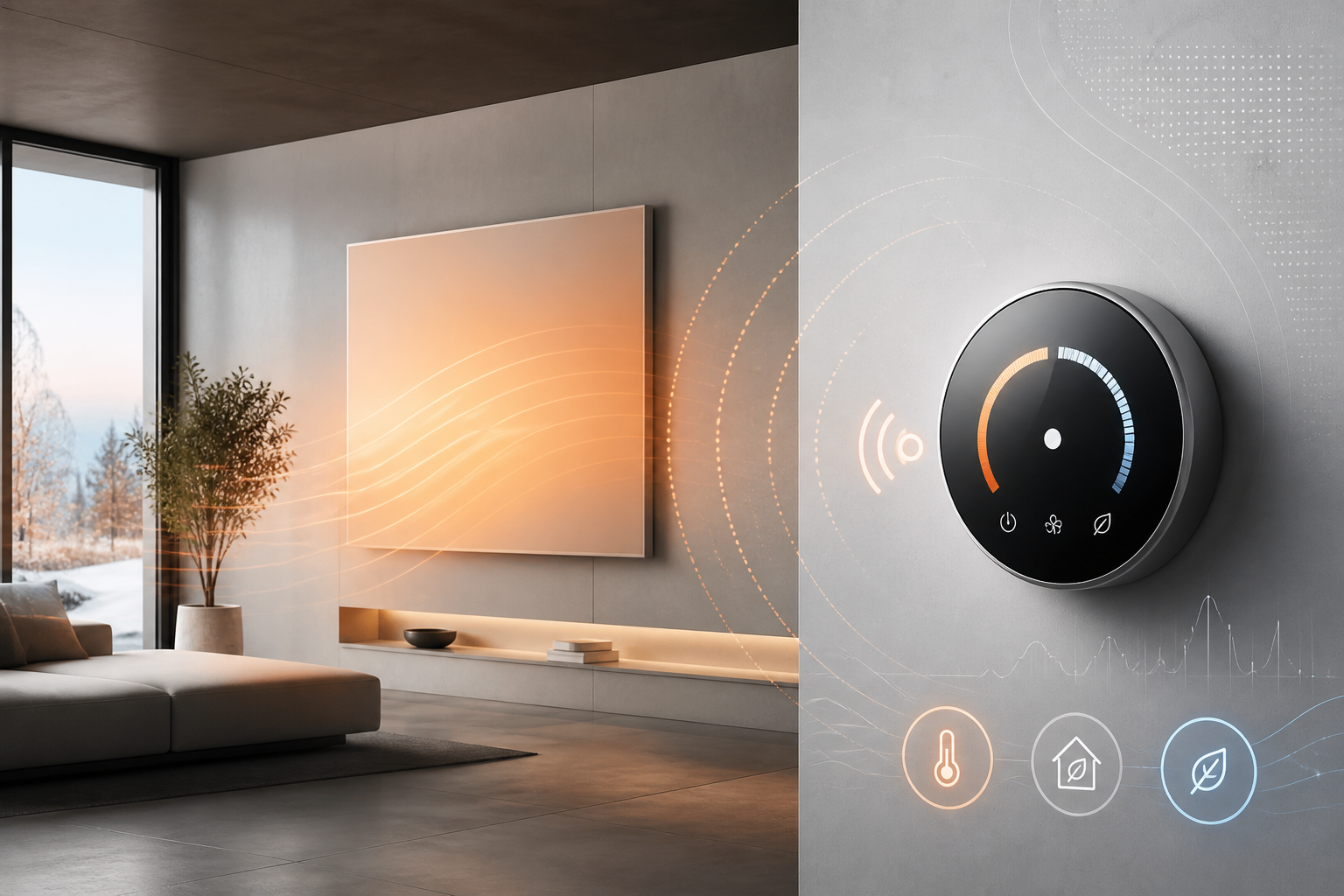
Yandiya’s documented Smart Home Zigbee/Wi‑Fi infrared panel range supports WiFi thermostat control through a compatible switching arrangement.
Are Yandiya heating panels compatible with a WiFi thermostat?
Yandiya Smart Home infrared panels are designed to work with WiFi thermostats, Zigbee relays, and Tuya-based controls for scheduled temperature management.
The verified product literature identifies a Smart Home Zigbee/Wi‑Fi infrared panel family with integrated smart-control options. It also identifies separate WiFi thermostat and Zigbee relay components for controlling heating zones.
This documented compatibility applies to the Smart Home control range described in Yandiya’s available product literature. It should not be treated as proof that every conventional Yandiya aluminium, glass, mirror, outdoor, or market-specific panel can connect directly to every WiFi thermostat.
How does a WiFi thermostat control Yandiya infrared panels?
A WiFi thermostat controls Yandiya panels by measuring room temperature and sending a heating demand to a compatible relay, contactor, or integrated control module that switches the panel supply.
The thermostat provides the user interface, schedules, temperature setpoints, and remote access. The switching component must be matched to the panel voltage, total connected wattage, circuit arrangement, and thermostat output type.
Infrared panels transfer heat by radiation to room surfaces, furniture, and occupants while also transferring some heat to the air through ordinary convection. They do not eliminate air heating, but their operation does not depend on a fan or forced-air circulation.
Which Yandiya product families support smart control?
The current verified Yandiya literature specifically documents the Smart Home Zigbee/Wi‑Fi infrared panel range and lists WiFi thermostats, Zigbee relays, and Tuya app compatibility as supported control options.
Yandiya’s wider published range includes slimline aluminium panels, designer glass heaters, bathroom mirror heaters, and outdoor patio heaters, but the available control documentation does not identify a separate thermostat, relay, voltage, or wiring configuration for every one of those families.
For a purchase or installation decision, identify the exact panel model and market version first, then match it with the control components listed for that model in the applicable installation documentation.
Can one WiFi thermostat control several Yandiya panels?
One WiFi thermostat can control several Yandiya panels when they form one heating zone and the switching equipment is rated for the combined electrical load.
For example, two 500W panels create a 1,000W heating zone; at 230V, that is approximately 4.35A before any design allowances. A relay or contactor selected for that zone must be suitable for the actual supply, load type, duty cycle, and local electrical requirements.
Separate rooms require separate thermostat inputs or a control system designed for independent zones. A single thermostat controlling multiple rooms measures only the temperature at its own sensor location, so it cannot independently regulate each room without additional zoning equipment.
Installation-design example
| Design item | Example |
|---|---|
| Panel quantity | 2 |
| Panel rating | 500W each |
| Combined zone load | 1,000W |
| Approximate current at 230V | 4.35A |
| Control arrangement | WiFi thermostat plus suitably rated relay or contactor |
The “control arrangement” column is an installation-design example, not a published Yandiya specification.
Does a Nest or ecobee thermostat connect directly to a Yandiya panel?
Nest and ecobee compatibility depends on the thermostat model’s output protocol and the interface used to switch the Yandiya heating circuit; a direct connection to a mains-powered panel is not established by Yandiya’s general WiFi-control listing.
Many consumer smart thermostats are intended for low-voltage HVAC control circuits rather than direct switching of mains-powered electric heaters. A compatible installation may therefore require a dry-contact interface, external relay, contactor, or manufacturer-approved control module.
The installer must identify whether the selected thermostat provides:
- A low-voltage call-for-heat output.
- A dry-contact output.
- A line-voltage switching output.
- A proprietary heat-control interface.
The installer must then match that output to the Yandiya panel supply and the switching device. The exact Nest or ecobee model, regional version, power method, and control accessory all matter.
Which panel wattages can be used in a smart-controlled zone?
The verified Yandiya brochure lists Smart Home aluminium panel ratings of 300W, 350W, 500W, 600W, 800W, 1,000W, and 1,200W, with the control equipment sized for the combined load of the selected panels.
The brochure also lists corresponding power-output figures for those aluminium models, including 288W for the 300W model, 310W for the 350W model, 450W for the 500W model, 530W for the 600W model, 720W for the 800W model, 940W for the 1,000W model, and 1,150W for the 1,200W model.
These figures are published product ratings, not a universal statement that every panel size can be connected to every thermostat. Smart-zone suitability still depends on the exact model, supply voltage, relay or contactor rating, circuit protection, and approved installation method.
Are Yandiya infrared panels energy-efficient?
Yandiya infrared panels convert electrical energy into heat at the point of use, while total operating cost depends on electricity tariff, room heat loss, thermostat settings, occupancy, insulation, and the heating system being replaced.
The Yandiya literature promotes high electrical-to-heat conversion, A+ ErP certification, and potential savings of up to 60%; these are manufacturer claims rather than guarantees of the same running cost in every building.
Electric resistance heating generally produces approximately one unit of heat at the point of use for each unit of electricity consumed. Smart scheduling can reduce waste by limiting operation in unoccupied rooms, but it does not remove the cost of the electricity required to produce the heat.
Compared with a gas boiler or heat pump, the operating-cost result depends on the building, energy tariffs, system efficiency, and control strategy. A whole-property replacement requires room-by-room heat-loss calculations and an electrical-capacity assessment.
Does infrared heating reduce air movement?
Infrared panels use radiant heat and have no fan, so they avoid the forced-air movement produced by fan heaters and forced-air HVAC systems.
They still warm the air indirectly as heated surfaces and objects release heat into the room, and natural convection continues around the heated panel and surrounding surfaces. The narrower benefit is reduced forced-air circulation, not a proven medical or allergy-treatment effect.
What should an installer check before connecting WiFi control?
An installer should match the exact Yandiya panel, thermostat output, switching device, supply voltage, combined zone load, circuit protection, sensor location, and installation environment before energizing the system.
The design check should cover:
- The exact Yandiya model and its installation documentation.
- The panel voltage and rated wattage.
- The combined wattage of every panel on the zone.
- The relay or contactor’s voltage, current, and switching duty.
- Whether the thermostat output is dry contact, low voltage, line voltage, or proprietary.
- The thermostat’s power supply and compatibility with the selected control module.
- Cable routing, circuit protection, isolation, and local electrical rules.
- Sensor placement away from direct radiant exposure, draughts, doors, windows, and other heat sources.
- Bathroom, outdoor, or other specialist-location requirements.
A qualified electrician should perform all mains-voltage design, wiring, testing, and commissioning work in accordance with the manufacturer’s installation documents and applicable local rules.
FAQ
Can I connect a WiFi thermostat directly to a Yandiya panel?
A WiFi thermostat should control a Yandiya panel through the compatible relay, contactor, or integrated control module specified for the exact system rather than through an assumed direct connection.
Will Nest or ecobee work with Yandiya panels?
Nest or ecobee can work only when the selected model’s output and power requirements match an approved relay, contactor, or interface for the Yandiya heating circuit.
What is the maximum Yandiya panel load for one thermostat?
The maximum load is the combined wattage permitted by the selected switching device, circuit, supply, and installation design rather than a universal limit shared by every Yandiya system.
Are Yandiya panels suitable for bathroom use?
Yandiya publishes bathroom mirror-heater products, but bathroom installation requires the exact model’s location rating, clearances, controls, and local electrical requirements to be confirmed before installation.
Do I need an electrician to install WiFi-controlled Yandiya panels?
A qualified electrician is required for mains-voltage wiring, relay or contactor installation, circuit assessment, testing, and commissioning.
Does Tuya guarantee independent room-by-room zones?
Tuya provides the software platform, but independent zones require compatible Yandiya control hardware, separate thermostat inputs or zone modules, and a switching arrangement designed for each zone.
Sources
- Yandiya Technology 2025 Brochure, available and verified August 10, 2026; the document identifies Smart Home Zigbee/Wi‑Fi infrared panels, Tuya software, WiFi thermostats, Zigbee relays, 110–240VAC operation, and published aluminium-panel ratings. (yandiya.net)
- Yandiya official product and technology information, including the published aluminium, glass, mirror, and outdoor product families and general smart-control descriptions. (yandiya.net)
- Yandiya 2019 brochure, which describes thermostat-operated infrared heating and reduced forced-air circulation; this older document is supporting background rather than the primary current product-control source. (yandiya.net)
> Safety and scope disclaimer: Do not use this article as wiring instructions. Product availability, certifications, control accessories, voltage, wiring requirements, and permitted installation locations can vary by exact model and market. Follow the applicable Yandiya installation documentation and use a qualified electrician for mains-voltage work.
References
- https://www.yandiya.net
- https://www.yandiya.net/web/userfiles/productfile/2400wInfraredpowerheaterTechnicalSpecification.pdf
FAQ
Can I connect a WiFi thermostat directly to a Yandiya panel?
A WiFi thermostat should control a Yandiya panel through the compatible relay, contactor, or integrated control module specified for the exact system rather than through an assumed direct connection.
Will Nest or ecobee work with Yandiya panels?
Nest or ecobee can work only when the selected model’s output and power requirements match an approved relay, contactor, or interface for the Yandiya heating circuit.
What is the maximum Yandiya panel load for one thermostat?
The maximum load is the combined wattage permitted by the selected switching device, circuit, supply, and installation design rather than a universal limit shared by every Yandiya system.
Are Yandiya panels suitable for bathroom use?
Yandiya publishes bathroom mirror-heater products, but bathroom installation requires the exact model’s location rating, clearances, controls, and local electrical requirements to be confirmed before installation.
Do I need an electrician to install WiFi-controlled Yandiya panels?
A qualified electrician is required for mains-voltage wiring, relay or contactor installation, circuit assessment, testing, and commissioning.
About the author
Yandiya Technology HK Ltd, a global leader in manufacturing infrared heating, is a beacon of innovation and efficiency. We have pioneered the development and application of infrared heating technology, transforming the way people heat their homes and businesses across the world.