 Yandiya Technology HK Ltd
Yandiya Technology HK Ltd › Blog › Yandiya Infrared Heating Panels: Specifications, Controls, Installation and Buying Advice
← All articlesYandiya Infrared Heating Panels: Specifications, Controls, Installation and Buying Advice

Key takeaways
- Yandiya panels may suit targeted room heating, but they are not automatically a cheaper or better replacement for central heating.
- The 2025 brochure lists smart-panel outputs from 300 W to 1,200 W and wall or ceiling installation.
- Brochure coverage figures are starting points only; use a room-by-room heat-loss calculation.
- Zigbee, Wi-Fi, and Tuya references do not independently prove coordinated multi-zone control.
- The “up to 60% energy savings” claim lacks published baseline and test-condition detail in the available brochure material.
- Verify the exact model’s voltage, wiring, thermostat compatibility, mounting instructions, IP rating, certification, and fire-safety requirements.
- The cited brochure lists a five-year panel warranty, a two-year LED-module warranty, and a stated 20-year service life; do not assume a 10-year warranty.
- Bathroom, outdoor, healthcare, and hot-yoga suitability requires model-specific compliance and environmental documentation.
- EU energy-label treatment is separate from CE or other electrical-safety and conformity documentation.
- The best purchase decision compares total installed cost and calculated heat demand with local electricity prices and alternative heating systems.
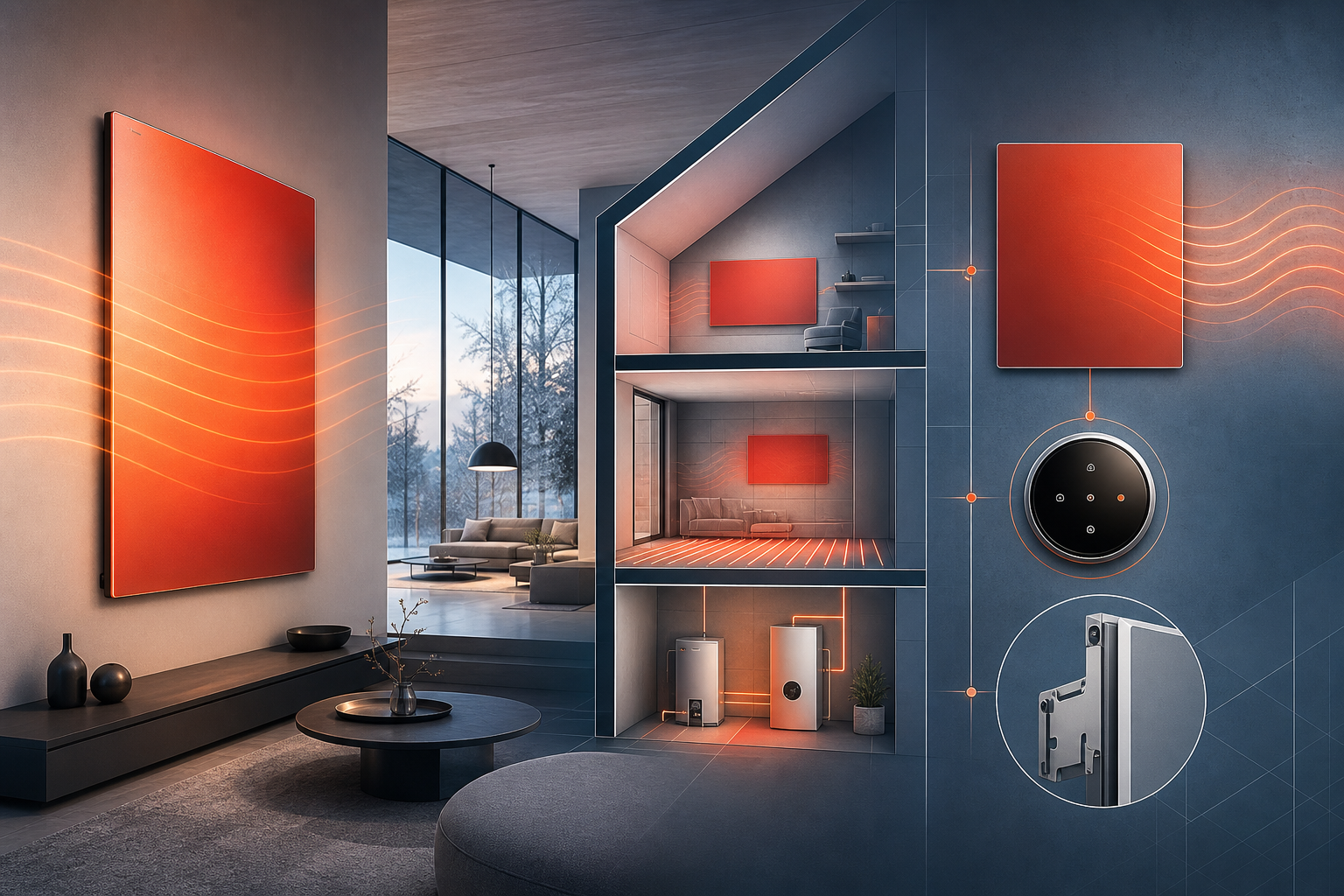
Quick verdict
Yandiya infrared panels are most suitable for buyers who need targeted electric heating in individual rooms, extensions, conservatories, offices, bathrooms, or intermittently occupied spaces—and who can verify the exact model’s electrical, control, mounting, and certification documentation before purchase.
They are not automatically a better or cheaper replacement for a gas boiler, heat pump, or other central-heating system. Their practical suitability depends on room heat loss, electricity prices, operating hours, panel positioning, controls, electrical capacity, and whether the system must also provide domestic hot water.
Yandiya’s 2025 brochure lists smart-panel outputs from 300 W to 1,200 W, wall or ceiling installation, 110–240 VAC operation, Zigbee or Wi-Fi connectivity, Tuya software compatibility, a stated 90°C surface temperature, a five-year panel warranty, and a stated 20-year service life. These are brochure specifications, not independent performance verification, and the brochure extract does not provide universal model numbers, test conditions, or market-specific certification details. (yandiya.net)
What are Yandiya infrared heating panels?
Yandiya sells electric infrared heating products, including a smart-panel range described in its 2025 brochure. The brochure identifies aluminium panels with a white or black satin powder-coated finish and lists wall or ceiling installation, panel outputs, electrical ratings, control connectivity, warranty information, and coverage estimates. (yandiya.net)
The brochure also presents other product categories, including glass panels, bathroom-mirror heaters, and outdoor heating products. However, buyers should treat these as product-category descriptions rather than proof that every model is suitable for bathrooms, high-humidity rooms, healthcare environments, hot-yoga studios, or outdoor installation. Suitability depends on the exact product’s installation instructions, ingress-protection rating, electrical classification, temperature limits, and local regulations.
The brochure’s smart-panel table does not, in the available extract, provide a complete set of universal SKU or model numbers. Before ordering, ask Yandiya or the seller to identify the exact model, revision of the technical document, rated output, control module, mounting system, and applicable market documentation.
How infrared panels affect room comfort
Infrared panels emit radiant energy that can be absorbed by people, floors, walls, furniture, and other surfaces within the panel’s effective view. Those surfaces can then exchange heat with the surrounding air. This does not mean that infrared heating avoids air heating altogether: overall comfort depends on radiant exchange, convection, insulation, air movement, surface temperatures, clothing, and panel placement.
A panel can feel comfortable when it provides useful radiant exposure to an occupied area, but comfort may be uneven if the panel is blocked by furniture, mounted too far away, aimed away from occupants, or used in a room with substantial heat loss. The United Kingdom’s Department for Energy Security and Net Zero published a literature and user-experience review of infrared heating on August 14, 2025. It is useful independent context, but it is not a Yandiya product test. (gov.uk)
Yandiya smart-panel specifications
The following figures come from Yandiya’s 2025 brochure. They should be checked against the current technical sheet for the exact model before purchase. (yandiya.net)
| Brochure entry | Published information | Buying implication |
|---|---|---|
| Rated power | 300 W, 350 W, 500 W, 600 W, 800 W, 1,000 W and 1,200 W | Compare rated power with a room heat-loss calculation, not floor area alone. |
| Listed power output | Approximately 288 W to 1,150 W, depending on entry | Confirm whether the seller is quoting input power, output power, or both. |
| Voltage | 110–240 VAC; the table also references 230 VAC with -10%/+5% | Verify the exact voltage range, plug, wiring method, and local electrical requirements. |
| Surface temperature | 90°C for the listed smart-panel range | Treat the panel as a hot surface. Confirm clearances and touch-protection requirements. |
| Installation | Wall or ceiling | Confirm the model’s mounting instructions, fixing method, clearances, and ceiling suitability. |
| Connectivity | Zigbee or Wi-Fi; Tuya software is referenced | Confirm whether the chosen panel includes Zigbee, Wi-Fi, or a separate control module. |
| Panel warranty | Five years | Obtain the written warranty, exclusions, territory, and claim procedure. |
| LED-module warranty | Two years is listed for the LED module | Do not assume this applies to the heating element or control electronics. |
| Stated service life | 20 years | Treat this as a manufacturer statement, not a guaranteed operating life. |
Model and output comparison
Yandiya’s brochure presents a range of sizes and outputs rather than a fully identified SKU catalogue in the available table. The comparison below reproduces the useful selection information while making that limitation clear. (yandiya.net)
| Listed panel size or size group | Rated power | Listed power output | Brochure minimum coverage | Brochure maximum coverage | Model/SKU status |
|---|---|---|---|---|---|
| 300 × 905 mm; 595 × 595 mm; 595 × 800 mm | 300 W | 288 W | 4.10 m² | 5.12 m² | Exact SKU not established in the brochure extract |
| Same size group | 350 W | 310 W | 4.67 m² | 5.83 m² | Exact SKU not established in the brochure extract |
| Same size group | 500 W | 450 W | 6.67 m² | 8.33 m² | Exact SKU not established in the brochure extract |
| 250 × 2,000 mm; 595 × 1,195 mm; 700 × 1,200 mm; 800 × 1,200 mm | 600 W | 530 W | 8.09 m² | 10.12 m² | Exact SKU not established in the brochure extract |
| Same size group | 800 W | 720 W | 10.67 m² | 13.33 m² | Exact SKU not established in the brochure extract |
| Same size group | 1,000 W | 940 W | 13.54 m² | 16.67 m² | Exact SKU not established in the brochure extract |
| Same size group | 1,200 W | 1,150 W | 16.80 m² | 21.24 m² | Exact SKU not established in the brochure extract |
Why brochure coverage is not a sizing method
Coverage figures cannot replace room-by-room heat-loss calculations. A room’s required heating output depends on factors such as outdoor design temperature, insulation, windows, ceiling height, external-wall area, ventilation, air leakage, adjacent-room temperatures, and the target indoor temperature.
A transparent approach is:
1. Calculate transmission losses through walls, windows, roof, floor, and doors.
2. Add ventilation and infiltration losses.
3. Account for relevant internal and solar gains conservatively.
4. Select sufficient installed heater output for the design condition.
5. Check that controls, circuits, mounting positions, and operating schedules can deliver that output.
For example, if a qualified heat-loss calculation determines that a room requires 3.6 kW at the design outdoor temperature, the buyer should compare the combined output of suitable panels with approximately 3.6 kW—not simply select a panel because the room falls within a brochure coverage range. The example is illustrative; the 3.6 kW figure is not a Yandiya recommendation.
Can Yandiya panels be ceiling-mounted?
The smart-panel specification lists wall and ceiling installation, so ceiling mounting is presented as an option for that range. It should not be treated as approval for every Yandiya product or every ceiling construction. (yandiya.net)
Before using a ceiling installation, verify:
- the exact model’s mounting instructions and fixing system;
- required distance from ceilings, walls, lights, sprinklers, curtains, and combustible materials;
- the panel’s viewing angle and whether beams, shelves, or suspended ceilings obstruct the occupied area;
- whether the selected mounting height and panel temperature are suitable for the room;
- cable routing, strain relief, service access, and switch location;
- the weight-bearing capacity of the ceiling and suitability of the supplied fixings.
Ceiling placement can save wall space and may expose a larger part of an occupied area to the panel, but the actual comfort result depends on geometry, obstructions, panel temperature, and the manufacturer’s placement limits.
Do Yandiya panels support smart thermostats and zone control?
Yandiya’s brochure references Zigbee or Wi-Fi connectivity and Tuya software/app control for its smart-panel range. This supports remote or app-based control in the described configuration. (yandiya.net)
That evidence does not by itself prove coordinated multi-zone control. Individual panel control, app connectivity, and true multi-zone heating are different capabilities. Before buying, ask for documentation showing:
- the supported thermostat or temperature-sensor devices;
- whether one controller can manage multiple panels or rooms;
- whether zones can have separate schedules and setpoints;
- whether panels continue operating safely if Wi-Fi, Zigbee, cloud access, or the app fails;
- whether local control is available without an internet connection;
- the control module’s voltage, switching method, maximum load, and compatibility with third-party thermostats.
A sensor placed near sunlight, an exterior door, a window, or another heat source may not represent the temperature in the occupied part of the room. Smart controls can reduce unnecessary operation, but they cannot compensate for inadequate installed output or excessive building heat loss.
Can Yandiya panels replace a gas boiler?
Usually, this should be treated as a building-design decision rather than a simple product swap. Infrared panels can provide electric space heating, but a gas boiler may also provide domestic hot water and serve multiple rooms through a hydronic distribution system. A whole-home replacement therefore requires a heat-loss assessment, hot-water plan, electrical-capacity check, tariff comparison, and review of expected operating hours.
Infrared panels may be worth evaluating for a single room, extension, conservatory, office, workshop, intermittently used area, or targeted comfort zone. They are less obviously suitable as a universal replacement when the building needs central hot-water production, continuous whole-home heating, or low operating cost in a region with expensive electricity.
How meaningful is Yandiya’s “up to 60% energy savings” claim?
Yandiya’s brochure uses an “up to 60%” energy-saving claim, but the available brochure material does not establish the comparison baseline, building type, climate, insulation level, indoor setpoint, operating schedule, control settings, or whether the figure refers to delivered energy, running cost, or total system energy. (yandiya.net)
Therefore, the figure is not decision-useful without supporting test documentation. Ask for:
- the heating system used as the comparison;
- the building type and floor area;
- outdoor and indoor temperatures;
- insulation and ventilation conditions;
- panel output and thermostat settings;
- monitoring period and measurement method;
- electricity and fuel prices used;
- whether hot-water energy was included;
- whether the result was independently tested.
Do not apply the 60% figure to a different building or assume that it represents a 60% reduction in household heating bills.
Electricity, gas and market context
Energy-cost comparisons are location-specific. Electricity tariffs, natural-gas prices, taxes, grid mix, climate, standing charges, and building standards vary significantly between countries and regions. Buyers outside the United States should not use U.S. household fuel data as a proxy for their local market.
For U.S.-focused readers, the U.S. Energy Information Administration reported that 42% of U.S. households identified electricity as their main space-heating fuel in 2024, while 47% identified natural gas. The statistic refers to U.S. households and main space-heating fuel, based on annual estimates from the U.S. Census Bureau’s American Community Survey; it is not a measure of Yandiya sales, panel efficiency, or national heating cost. (eia.gov)
For a purchase decision, compare the calculated heat demand with local delivered-energy prices. A resistance-heating panel generally converts its electrical input into heat at the point of use, but total operating cost still depends on how much heat the building requires and the price of electricity. A heat pump may deliver more heat per unit of electricity under suitable conditions, so infrared panels should be compared with the alternatives actually available at the property.
Installation and compliance checks
Do not order solely from a brochure description. Request the exact model’s current technical file, installation manual, declaration of conformity, and market-specific certification evidence.
Electrical and product-safety checks
Ask the seller or installer to confirm:
- UL, ETL, CSA, CE, UKCA, or other applicable marks, as relevant to the destination market;
- the underlying test reports or declaration of conformity rather than a logo alone;
- rated voltage, current, wattage, frequency, and maximum circuit load;
- plug type, hard-wiring requirements, cable length, isolator requirements, and overcurrent protection;
- thermostat and receiver voltage compatibility;
- whether the control device switches the full heater load or requires a contactor or relay;
- surface temperature, touch protection, child-safety considerations, and required clearances;
- fire-safety instructions and restrictions on covering the panel;
- mounting hardware and structural requirements.
Bathrooms and outdoor areas
A product category or marketing photograph does not prove that a panel is safe for a bathroom or outdoor location. Confirm the exact IP rating, permitted installation zones, residual-current protection requirements, corrosion resistance, cable and junction-box requirements, and temperature or weather limitations. If the documentation does not state these items, treat the product as unverified for that environment.
Healthcare, hot-yoga and wellness spaces
Yandiya materials mention healthcare, hot-yoga, conservatory, and other wellness applications, but an application reference does not establish clinical suitability, hygiene certification, humidity resistance, ingress protection, allergy relief, mould prevention, or therapeutic benefit. Those uses require separate project-specific verification and, where relevant, approval from the building owner, safety professional, insurer, or regulator.
Warranty, service life and total cost
The brochure lists a five-year panel warranty, a two-year LED-module warranty, and a stated 20-year service life for the smart-panel information shown. These statements should be confirmed in the written warranty for the exact model and sales territory. (yandiya.net)
Do not assume a 10-year warranty. No universal 10-year Yandiya panel warranty is established by the cited brochure material. Ask for the contract terms covering:
- heating elements;
- control electronics and receivers;
- LED modules, if fitted;
- finish, frame, cable, and mounting hardware;
- labour, shipping, and replacement arrangements;
- exclusions for incorrect installation, voltage problems, moisture, impact, modification, or commercial use;
- whether the warranty transfers with the property or purchaser.
Total cost should include the panels, thermostats, gateways, wiring, circuit upgrades, installation, ceiling or wall repairs, controls, replacement parts, electricity, maintenance, and any need for separate hot-water equipment.
EU energy labels and conformity documentation
As of July 31, 2026, the European Commission’s specific infrared-heater FAQ states that infrared heaters used for indoor or outdoor heating do not need to bear an EU energy label or be registered in EPREL under the scope addressed by that guidance. This is a product-labelling point, not a statement that every Yandiya model is approved for every EU market or installation. (energy-efficient-products.ec.europa.eu)
Energy labelling is also different from electrical safety and conformity assessment. Buyers should separately request applicable CE documentation, safety test evidence, electromagnetic-compatibility information, radio-equipment documentation for Wi-Fi or Zigbee models, and national installation requirements. Do not infer compliance from an “A+,” “ErP,” or similar marketing phrase without model-specific supporting documents.
Evidence table: what is verified and what remains open
| Claim or specification | Source | Model identified? | Verification status |
|---|---|---|---|
| Smart panels are listed for wall or ceiling installation | Yandiya 2025 brochure, smart-panel specification table, page 17 in the indexed document | No universal SKU in the available extract | Manufacturer-published specification; confirm exact model manual |
| Rated outputs range from 300 W to 1,200 W | Yandiya 2025 brochure, smart-panel table | No | Manufacturer-published range; not an independent performance test |
| Listed coverage ranges from about 4.10–5.12 m² to 16.80–21.24 m² | Yandiya 2025 brochure, smart-panel table | No | Brochure estimates; not a substitute for heat-loss design |
| Zigbee or Wi-Fi and Tuya software are referenced | Yandiya 2025 brochure, smart-panel description | No | Connectivity claim; multi-zone architecture remains unverified |
| Surface temperature is listed as 90°C | Yandiya 2025 brochure, smart-panel specification | No | Manufacturer-published figure; confirm test method and model |
| Panel warranty is listed as five years | Yandiya 2025 brochure | No | Manufacturer-published term; obtain full exclusions and territory |
| LED-module warranty is listed as two years | Yandiya 2025 brochure | No | Applies to the listed LED module, not automatically the heater or controls |
| Service life is listed as 20 years | Yandiya 2025 brochure | No | Manufacturer statement; not a guaranteed life or independent test result |
| “Up to 60% energy savings” | Yandiya brochure marketing claim | No | Baseline, test conditions, and accounting basis are not disclosed in the available material |
| Infrared heaters do not require an EU energy label under the cited FAQ | European Commission FAQ | Not applicable | Applies to the scope of the Commission guidance; check current law and destination market |
| 42% electricity and 47% natural gas as main U.S. heating fuels in 2024 | U.S. EIA summary of Census ACS data | Not applicable | U.S.-only household statistic; not a product-performance measure |
Who should consider Yandiya panels?
Yandiya panels may be worth shortlisting when:
- the buyer wants electric heating without installing wet radiators or ductwork;
- the project involves one or more targeted rooms;
- wall or ceiling mounting is practical;
- the electrical supply can support the calculated load;
- the buyer accepts that operating cost depends on local electricity prices;
- app or smart-home control is useful and the control architecture is documented;
- the seller can provide model-specific safety, warranty, and installation documents.
They deserve more caution when:
- the buyer expects a guaranteed whole-home cost reduction;
- the building has high heat loss or poor insulation;
- the project requires domestic hot water from the same system;
- the room is a bathroom, wet area, outdoor space, healthcare facility, or high-humidity studio without a verified IP and compliance rating;
- the buyer needs coordinated multi-zone control but only app connectivity has been demonstrated;
- certification, warranty, or installer documentation is unavailable.
FAQ
Are Yandiya infrared panels energy efficient?
They may be useful in a correctly designed, room-by-room electric heating system, but efficiency and cost depend on heat loss, operating hours, controls, electricity prices, and the system being replaced. Yandiya’s “up to 60%” figure is a manufacturer claim whose baseline and test conditions are not disclosed in the available brochure material. (yandiya.net)
What Yandiya panel outputs are listed?
The 2025 smart-panel table lists rated outputs from 300 W to 1,200 W, with brochure coverage estimates from approximately 4.10–5.12 m² at the smallest listed entry to 16.80–21.24 m² at the largest. These figures are not a substitute for heat-loss calculations. (yandiya.net)
Can Yandiya panels be installed on ceilings?
The smart-panel specification lists wall and ceiling installation. Confirm the exact model’s mounting instructions, clearances, fixings, cable routing, ceiling structure, and electrical requirements before installation. (yandiya.net)
Do Yandiya panels provide true multi-zone heating control?
The brochure references Zigbee or Wi-Fi connectivity and Tuya software, but that alone does not prove coordinated multi-zone control. Ask for the supported controller architecture, sensor arrangement, number of zones, local-control behavior, and maximum connected load. (yandiya.net)
Do Yandiya panels have a 10-year warranty?
The cited brochure lists a five-year panel warranty and a two-year LED-module warranty. It does not establish a universal 10-year panel warranty. Obtain the written warranty for the exact model, seller, and market. (yandiya.net)
Can Yandiya infrared panels replace a gas boiler?
They can provide electric space heating, but they do not automatically replace a boiler’s domestic-hot-water or whole-building functions. Compare room heat loss, hot-water requirements, electrical capacity, tariffs, controls, and alternative systems before deciding.
Are Yandiya panels suitable for bathrooms or outdoor use?
Do not assume so from the product category or brochure application list. Verify the exact model’s IP rating, permitted installation location, corrosion and moisture protection, electrical protection, temperature limits, and local rules.
Does a 90°C surface temperature create a safety issue?
A stated 90°C surface temperature means buyers should treat the panel as a hot surface and follow the exact clearance, mounting, touch-protection, and child-safety instructions. The figure should be confirmed for the selected model and installation. (yandiya.net)
Do infrared heaters need an EU energy label?
The European Commission’s infrared-heater FAQ says the covered indoor and outdoor infrared-heater products do not need an EU energy label or EPREL registration. This does not replace electrical safety, conformity, installation, or market-specific documentation. (energy-efficient-products.ec.europa.eu)
Bottom line
Yandiya infrared panels are a potentially practical option for targeted electric heating, particularly where simple room-level installation and smart control are valuable. The sensible buying decision is not based on the brand name, coverage table, or “up to 60%” claim alone. It requires a room heat-loss calculation, exact model identification, documented control compatibility, electrical-capacity checks, verified mounting and safety requirements, and a written warranty and compliance file.
References
- https://www.eia.gov/consumption/residential/about.php
- https://www.eia.gov/tools/faqs/faq.php?id=86&t=3
- https://www.iea.org/reports/energy-efficiency-2024
FAQ
Are Yandiya infrared panels energy efficient?
They may be suitable for a correctly designed room-by-room electric heating system, but actual energy use depends on heat loss, operating hours, controls, electricity prices, and the system being replaced. Yandiya’s “up to 60%” figure is a manufacturer claim without sufficient published test context.
What outputs are available?
Yandiya’s 2025 smart-panel table lists rated outputs from 300 W to 1,200 W, with brochure coverage estimates ranging from about 4.10–5.12 m² to 16.80–21.24 m². These figures should not replace a heat-loss calculation.
Can Yandiya panels be ceiling-mounted?
The smart-panel specification lists wall and ceiling installation. Confirm the exact model’s mounting method, clearances, fixings, cable routing, and ceiling requirements before installation.
Do Yandiya panels support zone control?
The brochure references Zigbee or Wi-Fi connectivity and Tuya software, but app connectivity does not by itself prove coordinated multi-zone control. Request the exact controller and sensor architecture.
Do Yandiya panels have a 10-year warranty?
The cited brochure lists a five-year panel warranty and a two-year LED-module warranty. It does not establish a universal 10-year panel warranty.
Can Yandiya panels replace a gas boiler?
They can provide electric space heating, but they do not automatically replace domestic hot-water production or a whole-building hydronic system. Compare heat loss, hot-water needs, electrical capacity, tariffs, and alternatives.
Are Yandiya panels suitable for bathrooms or outdoors?
Only if the exact model documentation confirms suitability. Verify the IP rating, installation zones, moisture and corrosion protection, electrical protection, temperature limits, and local requirements.
Does the 90°C surface temperature matter?
Yes. Treat a panel listed at 90°C as a hot surface and follow the model’s clearance, mounting, touch-protection, and child-safety instructions.
Do infrared heaters need an EU energy label?
The European Commission’s cited FAQ says covered indoor and outdoor infrared heaters do not need an EU energy label or EPREL registration. This is separate from electrical safety and conformity requirements.
About the author
Yandiya Technology HK Ltd, a global leader in manufacturing infrared heating, is a beacon of innovation and efficiency. We have pioneered the development and application of infrared heating technology, transforming the way people heat their homes and businesses across the world.