 Yandiya Technology HK Ltd
Yandiya Technology HK Ltd › Blog › How Far Infrared Heating Panels Warm People and Objects Differently From Convection Heaters
← All articlesHow Far Infrared Heating Panels Warm People and Objects Differently From Convection Heaters

Key takeaways
- Infrared panels heat people and surfaces directly through thermal radiation; convection heaters warm air first.
- Neither electric resistance technology is inherently more electrically efficient at the point of use.
- Infrared comfort depends on view factor, distance, panel temperature, angle, emissivity, clothing, air movement, and obstructions.
- Infrared can support zone or personal heating, but it does not guarantee uniform whole-room heating.
- A 39.1% energy-saving result came from a specific 2010 controlled study and should not be treated as a universal saving.
- Select panels using room heat loss, intended use, radiant-field analysis, controls, clearances, and local electrical-code requirements.
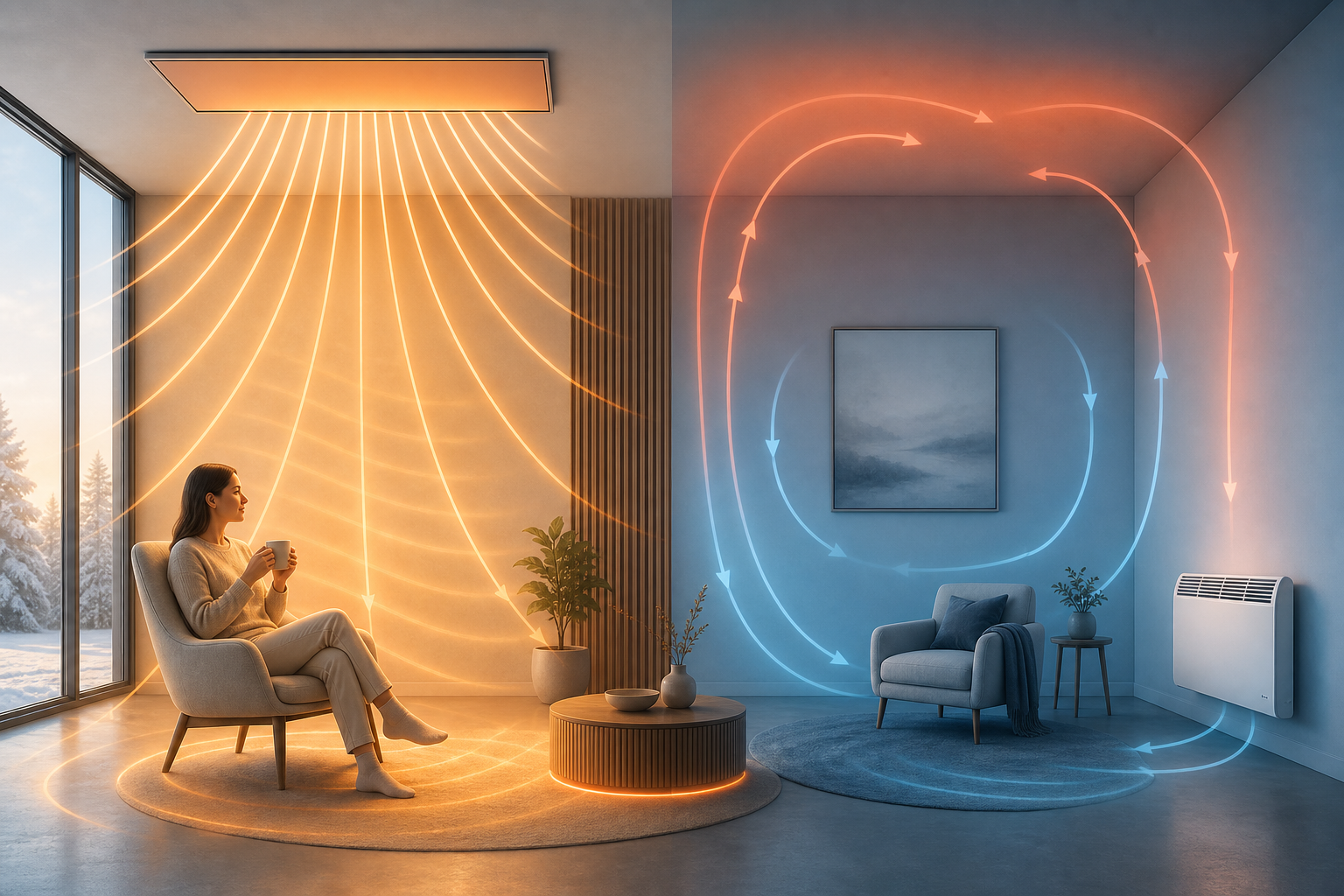
Far infrared heating panels and convection heaters both convert electrical energy into heat, but they deliver that heat differently. Infrared panels transfer thermal radiation directly to people and surfaces within their radiant field, while convection heaters warm nearby air first. Neither type is inherently more electrically efficient at the point of use when both are electric resistance heaters; differences in energy use usually come from sizing, controls, operating time, zoning, and the comfort target.
Infrared heating in one sentence
Infrared panels heat people and objects directly through thermal radiation, while convection heaters primarily heat air that then circulates through the room.
That distinction affects perceived warmth, air-temperature distribution, stratification, installation, sensor placement, and whether selective zone heating is practical.
What does “far infrared” mean?
“Far infrared” refers to a portion of the infrared spectrum with relatively long wavelengths. In domestic heating, however, the important mechanism is not a unique form of heat transfer. It is thermal radiation emitted by a warm surface.
Many electric panel products are marketed as “far infrared” or “long-wave infrared” heaters because their relatively moderate surface temperatures produce substantial long-wave thermal radiation. The label is therefore best treated as a product classification rather than proof of a fundamentally different heating mechanism from other radiant heaters.
A radiant panel also transfers some heat to the surrounding air by natural convection. The practical distinction is the first major route of heat delivery: radiation to people and surfaces for the panel, versus convection to air for the convector.
How do infrared panels warm people and objects?
Infrared panels emit thermal radiation that can be absorbed by occupants, furniture, walls, floors, ceilings, and other surfaces that have a suitable view of the panel. Those warmed surfaces can then release heat to the air and to nearby objects.
A panel does not heat every surface equally. Radiant transfer depends on factors including:
- View factor: how much of a surface is visible to the panel from the relevant position.
- Distance: radiant intensity generally decreases as distance increases.
- Panel temperature and emitting area: these affect the amount of radiation available.
- Surface emissivity: surfaces differ in how effectively they emit and absorb thermal radiation.
- Angle: a surface facing the panel usually receives more direct radiation than one viewed obliquely.
- Obstructions: partitions, tall furniture, closed doors, and equipment can create shaded areas.
Consequently, an infrared panel may warm a nearby wall or desk substantially while having little direct effect on a floor that is distant, poorly oriented, or blocked. A panel should not be assumed to heat all floors, walls, furniture, or room contents uniformly.
ASHRAE describes radiant systems as heating room surfaces and objects, which can subsequently contribute heat to the room air. The useful radiant field is therefore a design issue, not simply a property of the panel’s wattage. (handbook.ashrae.org)
Why panel location matters
A ceiling-mounted panel can provide broad exposure in an open room, but its effectiveness depends on mounting height, panel spacing, the arrangement of desks or seats, and obstructions below it. A wall-mounted panel may be better for a particular seating area or workstation, but it can create greater variation between positions.
This is why infrared systems may require multiple panels to provide more even coverage. Furniture rearrangement can also change the radiant field after installation.
How does a convection heater warm a room?
A convection heater transfers much of its output to nearby air first. As that air warms, it becomes less dense and rises; cooler air moves toward the heater, producing circulation.
After sufficient operating time, convection can produce a relatively even air temperature under suitable conditions, such as effective air mixing, appropriate heater placement, modest room height, and limited drafts. It is not guaranteed. Room geometry, furniture, air movement, heater location, and thermostat control can all create temperature differences.
Warm air rising may contribute to vertical stratification, with warmer air near the ceiling and cooler air at occupant level. High ceilings can make that pattern more pronounced because there is more air volume and vertical distance to mix. However, drafts and infiltration should be distinguished from stratification:
- Stratification is a temperature difference between parts of the room, often vertically.
- Drafts and infiltration increase heat loss and can create local discomfort, even when the room’s average air temperature is acceptable.
Air leakage does not automatically mean more stratification; its more direct effects are heat loss, cold surfaces, and unwanted air movement.
Why can infrared feel warm when the air is cooler?
Human thermal comfort depends on more than air temperature. It is influenced by air movement, clothing, activity, humidity, and the temperatures of surrounding surfaces.
Mean radiant temperature in plain English
Mean radiant temperature is an approximate temperature representing the combined radiant effect of the surfaces surrounding a person. Warm walls, ceilings, floors, windows, furniture, and heating panels can raise the radiant environment experienced by the occupant.
Operative temperature in plain English
Operative temperature is a practical comfort measure that combines air temperature with the surrounding radiant environment. Under specified low-air-movement conditions, ASHRAE states that it may be approximated by averaging air temperature and mean radiant temperature. (handbook.ashrae.org)
This explains why a person facing a warm panel may feel comfortable before the entire room’s air reaches the same temperature. It does not mean that the whole room is already warm, nor that every occupant will feel the same effect.
Perceived response depends on panel surface temperature, distance, exposure time, clothing, air movement, the person’s position, and how quickly the controls respond. Infrared may feel faster for someone inside the radiant field, but that should not be interpreted as faster whole-room heating.
Infrared panels versus convection heaters: side-by-side comparison
| Criterion | Infrared panel | Convection heater |
|---|---|---|
| Primary heat-transfer path | Radiation to people and surfaces, followed by secondary convection | Convection to air first, followed by air circulation and surface warming |
| Perceived response | Can feel immediate within the radiant field if exposure is adequate | Usually depends more on the room air warming first |
| Whole-room air temperature | May remain uneven during early operation or zone heating | Can become relatively even when room mixing and placement are suitable |
| Stratification | Often less dependent on warm-air circulation, but not automatically eliminated | May occur because warm air rises, especially in tall rooms |
| Draft sensitivity | Direct radiant comfort can remain useful, but drafts still increase heat loss and discomfort | Drafts can directly reduce air temperature and comfort near occupants |
| Zoning | Well suited to occupied zones, desks, seats, and intermittent use | Usually heats the air volume of the room or zone served |
| Obstructions | Partitions and furniture can shadow occupants and surfaces | Obstructions can restrict air circulation but do not create the same line-of-sight limitation |
| Sizing | Requires heat-loss assessment plus radiant-field and mounting analysis | Requires heat-loss assessment, air distribution, and placement analysis |
| Controls | Sensor position is important; operative-temperature or carefully located air sensors may be appropriate | Air-temperature thermostats are commonly used, but placement still affects performance |
| Main strengths | Direct personal comfort, quiet operation, zoning, and limited preheating of air | Familiar room-wide heating, straightforward air-temperature control, and broad availability |
| Likely best use cases | Intermittently occupied or zone-based spaces, workstations, and targeted supplemental heating | Enclosed rooms requiring sustained air-temperature control |
Are infrared panels more energy efficient than convection heaters?
At the point of use, electric infrared panels and electric convection heaters are both forms of resistance heating. In practical terms, nearly all electricity entering the resistance element becomes heat in the building, although the delivered result can also be affected by controls, standby consumption, thermostat accuracy, distribution, and heat losses. The U.S. Energy Information Administration describes electric resistance heating as converting incoming electricity to heat at approximately 100% efficiency. (eia.gov)
Therefore, a 500-watt infrared panel and a 500-watt electric convector draw approximately the same power while each is operating at full output. A 500-watt heater operating continuously for two hours uses 1 kilowatt-hour.
That comparison does not mean the two systems will necessarily use the same electricity over a day. Daily consumption depends on:
- thermostat cycling and control accuracy;
- whether the panel modulates or operates only on/off;
- standby and control-system draw;
- the building’s heat loss;
- weather and air leakage;
- occupancy schedules;
- whether the system heats a whole room or only an occupied zone;
- the selected air-temperature or comfort setpoint; and
- whether both systems are sized and controlled to provide equivalent comfort.
The potential advantage of infrared is therefore a system-level operating strategy, not superior resistance conversion. Directly heating occupied areas may reduce the need to preheat unused air volume. That benefit is conditional and can disappear if panels are poorly located, undersized, overexposed to cold external surfaces, or operated continuously to compensate for inadequate capacity.
What does the 39.1% study result actually show?
A 2010 paper by Ahmed Hamza H. Ali and Mahmoud Gaber Morsy, titled *Thermal Perception and Energy Consumption: A Comparative Study Between Radiant Panel and Portable Convective Heaters*, was published in *Energy Efficiency*, volume 3, pages 283–301. The study used an environmentally controlled test room and a separate office-room experiment. Its reported conditions included a 4.2 m × 3.2 m × 2.75 m test room, outdoor-environment temperatures of 0°C, 5°C, and 10°C, two 290-watt radiant panels, and a 670-watt portable natural-convection oil heater. The office experiment also used a small room-scale setup with temperature measurements over a 24-hour period. (researchgate.net)
The paper reported:
- up to 39.1% lower daily energy consumption in a thermal-dummy comparison when radiant heating achieved a similar thermal-perception outcome at a lower air temperature;
- about 13.4% energy saving in one human-subject comparison using two radiant panels totaling 580 watts versus a 670-watt convector; and
- about 56.7% energy saving in a 10°C outdoor-condition comparison using one 290-watt radiant panel versus the 670-watt convector.
The paper’s human-subject result was a reported thermal sensation or comfort vote outcome, not proof of a universal comfort advantage. The accessible study material does not establish that these results generalize to all buildings, climates, occupants, panel designs, or control strategies. The test room was relatively specific, the comparisons were short and controlled, and the baseline was not equivalent to every possible convection system.
The 39.1% figure should therefore be read as a result from a particular test duration, room, weather condition, heater arrangement, and control method—not as a guaranteed household saving or a general efficiency rating. (researchgate.net)
What should you consider when choosing infrared panels?
Start with the intended use. Sizing differs substantially depending on whether the panels will provide:
1. Primary heating: the panels must meet the room or building design heat loss during cold conditions.
2. Supplemental heating: the panels cover part of the load alongside another heating system.
3. Spot or personal heating: the goal is to warm occupants in defined positions rather than maintain the entire room at a uniform temperature.
4. Zoned heating: different rooms or occupied areas operate on separate schedules and setpoints.
A heat-loss calculation is more reliable than selecting wattage from floor area alone. Consider insulation, windows, outdoor design temperature, ceiling height, air leakage, occupancy, ventilation, desired comfort level, and the location of cold surfaces.
Office and ceiling installation
Ceiling-mounted panels can work well in offices when desks and occupants have suitable exposure to the panels. The design should account for:
- mounting height and panel spacing;
- desk arrangement and partitions;
- radiant asymmetry between different seating positions;
- glare or visual discomfort from panel finishes or indicator lights;
- surface-temperature and fire clearances;
- access for maintenance;
- sensor location; and
- local electrical, building, and fire-code requirements.
A ceiling installation should not be specified solely from the room’s floor area. A qualified designer or installer should confirm the layout and clearances.
Bathrooms and wet areas
Bathroom installations require particular care. Check the product’s IP rating, permitted electrical zones, fixed-wiring requirements, RCD/GFCI protection, clearances, bonding and earthing requirements, and all applicable local codes.
An anti-fog mirror heater is not automatically interchangeable with a general-purpose room-heating panel. It may have a different output, enclosure, mounting method, and safety approval. Wet-area electrical work should be assessed and completed by a qualified installer.
Yandiya panels: separate product claims from general heating principles
The general comparison above describes radiant and convective heating principles. Yandiya-specific features should be treated separately because they are based on company documentation rather than independent validation.
Yandiya’s 2025 brochure lists infrared panel options from 300 watts to 1,200 watts and states surface temperatures of approximately 90°C for relevant products. It also describes smart-control options, including Zigbee, Wi-Fi, and Tuya-related compatibility. These are manufacturer claims and specifications, not independent performance findings. (yandiya.net)
The brochure’s wattage examples illustrate available product sizes, but wattage is not the same as guaranteed coverage. Any nominal coverage example depends on assumptions about insulation, outdoor temperature, ceiling height, mounting position, glazing, occupancy, control strategy, and desired indoor temperature. A product brochure should not replace a room-by-room heat-loss calculation or a radiant-field assessment.
Disadvantages and limitations of infrared panels
Infrared panels can be useful, but they are not universally superior. Important limitations include:
- Line-of-sight dependence: people and surfaces outside the radiant field may receive less direct heat.
- Shadowing: furniture, partitions, shelving, and equipment can block radiation.
- Uneven comfort: occupants at different angles or distances may experience different radiant exposure.
- Surface-temperature risk: panels and nearby surfaces can become hot enough to require clearances and contact precautions.
- Furniture constraints: rearranging a room can change the heating pattern.
- Sensor placement: a thermostat in direct radiation may read differently from one in a shaded location.
- Multiple-panel requirements: uniform coverage may require more than one panel and careful spacing.
- Air-quality limitations: infrared panels do not provide ventilation or remove humidity and pollutants.
- Building-envelope dependence: poor insulation, air leakage, and cold windows can still create discomfort and high heat demand.
When is infrared a better fit than convection heating?
Infrared panels are often a good fit when the priority is direct comfort in occupied zones, especially in intermittently used rooms, workstations, reception areas, workshops, wellness spaces, or other locations where heating the entire air volume is unnecessary.
Convection heating may be a better fit when the priority is maintaining a broadly uniform air temperature throughout an enclosed room for long periods and when the room’s air distribution is straightforward.
Neither system automatically replaces a heat pump, boiler, or furnace. Heat pumps move heat and can use less electricity than resistance heaters for whole-building space heating under suitable conditions. Boilers may also provide domestic hot water and serve multiple zones. A full system comparison should include heat loss, hot-water requirements, electrical capacity, tariffs, controls, installation cost, and local code requirements.
Decision guide
Choose infrared panels when:
- occupants need heat in specific zones;
- the space is used intermittently;
- direct radiant comfort is valuable;
- quiet operation is important;
- the layout allows a clear radiant path; and
- the system can be properly sized and controlled.
Choose convection heating when:
- the goal is sustained room-wide air-temperature control;
- air mixing is acceptable and predictable;
- the room has relatively simple geometry;
- line-of-sight limitations would be inconvenient; or
- the existing system already distributes heat effectively.
Consider a heat pump or another system when whole-building energy consumption is the main priority and the building, climate, electrical supply, and installation budget support it.
Conclusion
Far infrared panels and convection heaters warm spaces by different primary routes. Infrared panels transfer heat directly to people and surfaces within their radiant field; convection heaters warm air first. Infrared can feel more immediate to an exposed occupant and can support zone heating, but its performance depends strongly on view factor, distance, panel temperature, obstructions, controls, and mounting design.
Both electric resistance technologies produce roughly the same heat per unit of electricity at the point of use. Any operating-cost advantage from infrared comes from how the system is sized, zoned, scheduled, and controlled—not from a fundamentally higher electrical conversion efficiency. A heat-loss calculation and a realistic assessment of the radiant field are essential before selecting panels as primary, supplemental, or personal heating.
FAQ
Do far infrared heating panels heat the air?
Yes, but mainly as a secondary effect. The panel first transfers radiation to people and surfaces within its radiant field. Those surfaces then release some heat to the surrounding air through convection. The panel also loses some heat directly to air from its own surface.
Can infrared heat through furniture?
No. Infrared radiation does not normally pass through ordinary furniture, walls, doors, or opaque partitions. Furniture can absorb radiation, but it can also block the panel’s radiation and create shadowed areas behind it.
Are infrared panels cheaper to run than convection heaters?
Not automatically. Equal-wattage electric resistance heaters use approximately the same power at full output. Infrared may reduce energy use when it allows effective zone heating, shorter operating periods, or a lower air-temperature setpoint while maintaining acceptable comfort. Actual results depend on the building and controls.
Do infrared panels work in rooms with high ceilings?
They can, but mounting height, panel output, spacing, angle, and occupant exposure become more important as the ceiling rises. A high ceiling does not automatically prevent infrared heating, but it can increase distance and make uniform coverage more difficult. A design calculation is recommended.
Can an infrared panel replace a convection heating system?
Sometimes, but not by simply substituting one heater for another. If the panel is primary heating, its total output must meet the room’s heat loss. The layout must also provide adequate exposure to occupied areas. Supplemental or spot-heating applications require different sizing from whole-room heating.
Is a 500-watt infrared panel more efficient than a 500-watt convector?
At full output, both generally draw about 500 watts and convert nearly all of that electricity into heat. Their daily consumption can differ because thermostats, duty cycles, control accuracy, placement, and heating strategy differ.
Can I install an infrared panel in a bathroom?
Only if the specific product is approved for the location and installed according to applicable wet-area electrical rules. Check the IP rating, electrical zones, RCD/GFCI protection, fixed wiring, clearances, and local code requirements with a qualified installer. Do not assume a general heating panel can replace a purpose-designed anti-fog mirror heater.
Sources
- ASHRAE, “Chapter 16: Infrared Radiant Heating,” ASHRAE Handbook. Definitions and discussion of radiant heating, operative temperature, mean radiant temperature, sensor placement, and radiant-system behavior. Accessed July 31, 2026. (handbook.ashrae.org)
- **Ali, Ahmed Hamza H., and Mahmoud Gaber Morsy, “Thermal Perception and Energy Consumption: A Comparative Study Between Radiant Panel and Portable Convective Heaters,” *Energy Efficiency*, 3, 283–301, 2010.** Experimental comparison of radiant panels and a portable natural-convection oil heater, including the reported 580-watt, 670-watt, and 39.1% results. Accessed July 31, 2026. (researchgate.net)
- U.S. Energy Information Administration, “Residential Electric Resistance Unit Heaters,” March 2023. Supports the more precise statement that electric resistance heating converts incoming electricity to heat at approximately 100% at the equipment point of use. Accessed July 31, 2026. (eia.gov)
- Yandiya, “Infrared Heating: Technology 2025 Brochure.” Manufacturer documentation for product ranges, stated surface temperatures, controls, and nominal product information; not independent validation. Accessed July 31, 2026. (yandiya.net)
References
- https://doi.org/10.1007/s12053-010-9077-3
- https://pmc.ncbi.nlm.nih.gov/articles/PMC4580902
- https://www.eia.gov/analysis/studies/buildings/equipcosts/pdf/full.pdf
- https://doi.org/10.1016/j.enbuild.2026.117112
FAQ
Do far infrared heating panels heat the air?
Yes, but mainly as a secondary effect. They first transfer radiation to people and surfaces, which then release some heat to the air by convection.
Can infrared heat through furniture?
No. Ordinary furniture and opaque partitions block infrared radiation, although furniture surfaces can absorb radiation and become warm.
Are infrared panels cheaper to run than convection heaters?
Not automatically. Equal-wattage electric resistance heaters use approximately the same power at full output. Infrared may save energy through zoning, scheduling, and targeted comfort.
Do infrared panels work with high ceilings?
They can, but mounting height, distance, panel spacing, output, and occupant exposure become more important. A design calculation is recommended.
Can an infrared panel replace a convection heating system?
Sometimes, provided the panels are sized for the room’s heat loss and installed to provide adequate radiant exposure. Supplemental and spot heating require different sizing from whole-room heating.
Is a 500-watt infrared panel more efficient than a 500-watt convector?
At full output, both generally draw about 500 watts and convert nearly all incoming electricity into heat. Daily consumption depends on duty cycle, controls, placement, and operating strategy.
Can I install an infrared panel in a bathroom?
Only when the product is approved for the location and installed according to wet-area electrical rules. Check IP rating, electrical zones, RCD/GFCI protection, clearances, wiring, and local codes with a qualified installer.
About the author
Yandiya Technology HK Ltd, a global leader in manufacturing infrared heating, is a beacon of innovation and efficiency. We have pioneered the development and application of infrared heating technology, transforming the way people heat their homes and businesses across the world.